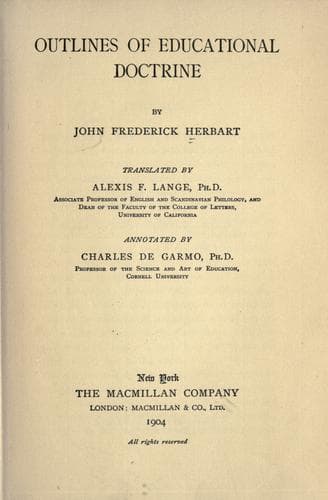
Outlines of Educational DoctrineHerbart, Johann Friedrich
Philosophy
Outlines of Educational Doctrine
Herbart, Johann Friedrich
Education -- Philosophy
brilliant side first, namely, as orator, need scarcely be mentioned.
Later on his philosophical writings become important; but many passages
require a fuller development of the subject-matter than is given by him.
Cicero should frequently be read aloud, or rather declaimed, by the
teacher. An orator demands the living voice; the usual monotonous
reading by the pupils fails to do justice to him. As regards Tacitus
for school use, there is a difference of opinion. Generally speaking,
authors that say much in few words are particularly welcome, not
merely to the explaining teacher, but also to the responsive pupil.
The opposite is true of Cicero; he must be read rapidly in order to be
appreciated.
For a full discussion of Latin texts to be read, the reader is
referred to Professor Bennett’s chapters on “The Teaching of Latin
in the Secondary Schools,”[42] pp. 111–130. For a discussion of the
Greek texts, see Professor Bristol’s exposition in the same volume.
[42] Bennett and Bristol, “The Teaching of Latin and Greek,” Longmans,
Green & Co., New York, 1900.
285. Experience has long since shown how much or how little can be done
with students in Greek and Latin composition; and no method will ever
be devised which would induce earlier than at present that degree of
mental maturity which reveals itself in a good Latin style. So long as
gymnasium pupils are no more select than they now are, the majority,
so far as writing Latin is concerned, will begin something that will
never lead to successful performance. It would be better, instead, to
practise diligently that which can be achieved, namely, composition
during the recitation hour, with the assistance of the teacher, and,
afterward coöperative consideration of the appointed task, by the
pupils. This plan secures the advantage of set essays without the
disadvantage of innumerable mistakes, the correction of which the pupil
rarely remembers. Joint labor is interesting, and can be adapted to
every age. As a substitute for essays, abstracts in Latin of texts
previously interpreted are to be recommended, these abstracts to be
made at first with the help and afterward without the help of the book
in question. To abstract does not mean to imitate, and ought not to
mean that. To imitate Cicero requires Cicero’s talent, and unless this
exists, the attempt to imitate, it is to be feared, will result in
cold artificiality. Even Cæsar is not so simple that his style could
be taught and learned. But many passages of Cæsar may be memorized; at
first short sentences, then longer periods, finally whole chapters. The
usefulness of this practice is attested by experience.
CHAPTER VII
=Further Specification of Didactics=
286. The more precise determination of the theory of instruction
depends on the nature of particular subjects of instruction, on the
individuality of the pupil, and on the external conditions of ethical
life.
Public-domain text, read in full here on John Shaqi.
Reviews
Reviews
No reviews yet
Be the first to share your thoughts on this work.
Elsewhere in the archive
Join the Discussion
Join the discussion
Sign in to leave a comment or review.
Sign InorCreate an account