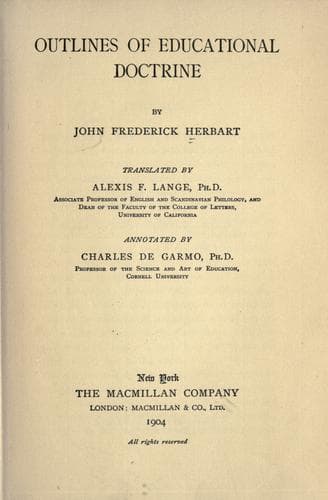
Outlines of Educational DoctrineHerbart, Johann Friedrich
Philosophy
Outlines of Educational Doctrine
Herbart, Johann Friedrich
Education -- Philosophy
Some always know the right moment and whither it calls them; they
always perform the nearest duty, and have their stock of knowledge
uniformly well in hand. Others bury themselves in thought, and give
themselves up to hopes and fears, to plans and projects: they live
in the past or in the future, resent being disturbed by the present,
and require time and effort to bring themselves back to it. Between
the former and the latter are found others, who do indeed note the
given and the present, not, however, to take it as it appears, but
rather to look beyond, for the purpose of spying what lies concealed
behind, or in order to move, displace, interfere, perhaps to distort,
ridicule, and caricature. With many the tendency described is merely
superficial. They play and tease--a common manifestation of youthful
animal spirits. Now the question arises: how much seriousness lies
back of the playfulness. How much depth beneath the animated surface?
Here temperament enters as a factor. The play of one with a sanguine
temperament comes to an end; but where sourness of temper is habitual,
there danger threatens, if, as commonly happens, sport turns to
earnest. Self-assertion plays a part also, manifesting itself in
various ways. It assumes one form in him who has confidence in his
strength, physical or mental, and another form in those who know their
weakness--with or without the mental reservation as to the future
employment of artifice or cunning, and so also with more or less
acknowledgment of the superior power or authority. Passionate playing,
on the whole, implies little seriousness; but may well indicate
sensitiveness and a propensity to freedom from restraint. Prudence in
sport is a sign of ability to take the opponent’s point of view, and
to foresee his plans. Love of play is far more welcome to the teacher
than indolence, or languid curiosity, or gloomy seriousness; it is one
of the minor faults, if now and then work is forgotten over a game and
time wasted; the situation is more grave, sometimes very grave indeed,
where extravagance, or greed of gain, or secretiveness, or bad company
is involved. In such cases decided interference on the part of the
teacher is necessary.
296. Since courage and rationality grow with increasing years, the
faults of mere weakness leave room for hope of improvement, although
there is need of an invigorating mode of life, invigorating physically
and mentally, and of counsel and reproof in particular instances. Under
continued watchful care weak natures improve much more than at first
thought would seem to be likely.
Public-domain text, read in full here on John Shaqi.
Reviews
Reviews
No reviews yet
Be the first to share your thoughts on this work.
Elsewhere in the archive
Join the Discussion
Join the discussion
Sign in to leave a comment or review.
Sign InorCreate an account