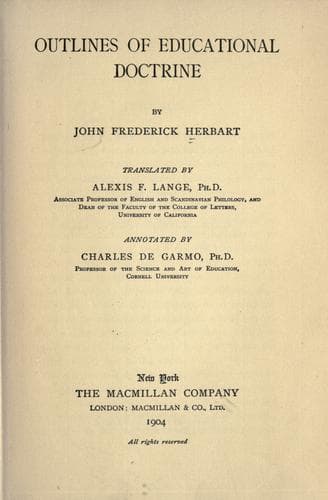
Outlines of Educational DoctrineHerbart, Johann Friedrich
Philosophy
Outlines of Educational Doctrine
Herbart, Johann Friedrich
Education -- Philosophy
297. Unsteadiness, continual restlessness, where they accompany good
health without being the result of external stimulation, are doubtful
indications. Here it will be well to look to the sequence of thoughts.
Where, in spite of variableness in general, thoughts are sound and
well connected, this restlessness is not a serious matter. The case is
worse when the opposite is true, especially when the vascular system
appears very irritable, and dreamlike reveries occur. Here the danger
of insanity is seen lurking in the distance.
The appropriate treatment for such pupils consists in holding them
strictly to definite tasks, especially to those occupations that
compel a close observation of the external world, and in exacting the
performance of the work assigned, without failing to encourage whatever
is undertaken from choice.
298. Sensual impulses and violence of temper are apt to go from bad to
worse as pupils grow older. Against these, careful supervision, earnest
censure, and the whole rigor of moral principles must be brought to
bear. Momentary ebullitions of passion, however, unless persistently
obstinate attempts are made to justify them, need to be handled gently,
that is, as evils calling for precaution and vigilance.
299. The faults hitherto noted lie for the most part on the surface.
Others have to be studied as occasion offers in instruction.
There are minds so dull that even the attempt merely to secure
connection with definite portions of such thoughts as they have
does not succeed. Easy questions intended to raise their ideas into
consciousness only increase the resistance to be overcome. They are
seized with embarrassment from which they seek to escape, sometimes by
a simple, “I don’t know,” sometimes by the first wrong answer that
comes to hand. Mental activity has to be enforced, yet remains feeble
at best, and it is only in after years, under pressure of necessity,
that they acquire some facility for a limited sphere. Others, whom one
would be inclined to call contracted rather than generally limited,
because by them reproduction is performed successfully but within a
narrow compass, exhibit a lively endeavor to learn, but they learn
mechanically, and what cannot be learned in that way they apprehend
incorrectly. These undertake, nevertheless, to form and express
judgments, but their judgments turn out to be erroneous; hence they
become first discouraged and then obstinate. Again, there are those
whose ideas cannot be dislodged, and still others whose ideas cannot
be brought to a halt. These two classes call for a more detailed
consideration.
Public-domain text, read in full here on John Shaqi.
Reviews
Reviews
No reviews yet
Be the first to share your thoughts on this work.
Elsewhere in the archive
Join the Discussion
Join the discussion
Sign in to leave a comment or review.
Sign InorCreate an account