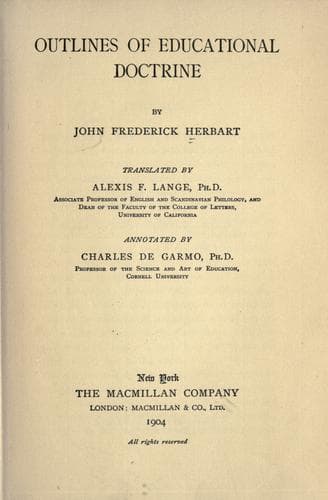
Outlines of Educational DoctrineHerbart, Johann Friedrich
Philosophy
Outlines of Educational Doctrine
Herbart, Johann Friedrich
Education -- Philosophy
328. Here the pupil’s capacity for education, as well as the limits
of that capacity, are brought home to the teacher. As boys approach
manhood, they let birth and external circumstances designate for
them that class of society to which they will belong. The class
defined, they seek to acquire its form of life, and to get into its
main current. On the way thither they accept and take along so much
of higher motives, of knowledge and insight, as, on the one hand,
instruction offers and training favors, and as, on the other hand,
the individuality of each one, which the earliest impressions have
further determined, is ready to assimilate. Those are rare exceptions
who, through the development of an absorbing interest of some kind,
in religion, or science, or art, have become less susceptible to the
attractive force of their social class. Their course has been marked
out by the instruction which induced the absorption; henceforth they
are self-actively engaged in the pursuit of whatever accords with the
end in view, and accept only a small part of what is presented to them.
329. Specific forms of a pupil’s attitude toward society, especially
the relative prominence in his mind of state or family relations, will
have to receive due consideration in marshalling motives to counteract
particular faults. Indeed, the same is true of the appeal to those
motives through which it is sought to establish a preponderance of
worthier endeavor over moral imperfection in general.
SECTION III
REMARKS ON THE ORGANIZATION OF EDUCATION
CHAPTER I
=Home Education=
330. On discovering that his own efforts encounter impediments, the
individual teacher might easily come to think that society could
do everything, if it only would, and if it possessed the necessary
insight. Further reflection, however, reveals the existence of
difficulties peculiar both to state and family.
331. The state needs soldiers, farmers, mechanics, officials, etc., and
is concerned with their efficiency. Its attitude toward a large number
of persons, whose existence as individuals has significance only in a
narrow sphere, is, in general, far more that of supervision designed to
prevent the harm they might do, than one of direct helpfulness. He who
is able to render competent service receives preferment; the weaker has
to give way to the stronger; the shortcomings of one are made good by
another.
332. The state applies its tests to what can be tested, to the outward
side of conduct and of knowledge. It does not penetrate to the inner
life. Teachers in public schools cannot penetrate much farther; they,
too, are more concerned with the sum total of knowledge imparted by
them, than with the individual and the way in which he relates his
knowledge to himself.
Public-domain text, read in full here on John Shaqi.
Reviews
Reviews
No reviews yet
Be the first to share your thoughts on this work.
Elsewhere in the archive
Join the Discussion
Join the discussion
Sign in to leave a comment or review.
Sign InorCreate an account