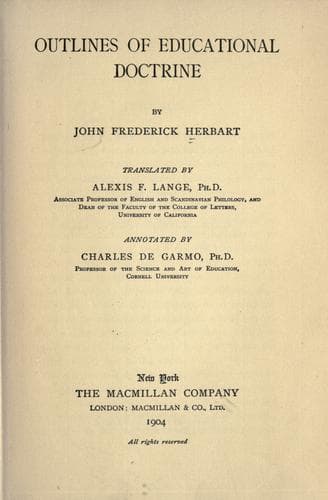
Outlines of Educational DoctrineHerbart, Johann Friedrich
Philosophy
Outlines of Educational Doctrine
Herbart, Johann Friedrich
Education -- Philosophy
324. On the restoration of perfect order after a period during which
government and training were lacking, a large number of faults will
disappear of themselves, and accordingly do not require to be combated
one by one. Respect for order, and incentives sufficiently strong to
regular activity, are the main things.
325. Faults which the pupil seems to possess are often only the
borrowed maxims of the society which he hopes to enter. Here it becomes
the business of education to set him right, if possible, and to
elevate his view of human relations, in order that he may disdain the
false appearances he before held in esteem.
326. Faults which an older pupil actually possesses rarely occur
singly. Moreover, they are seldom fully disclosed; their appearance is
determined by a prudent regard for circumstances. During the period of
education such faults can, indeed, be largely prevented from growing
worse, but the radical improvement of those who are secretive from
prudence is rarely to be thought of before they have become more
prudent still, too proud for concealment, and more susceptible to the
true estimate of moral values.
Where older boys and young men are found to possess unused talents, and
where instruction can be so arranged as to develop them, there is some
prospect of supplying a counterbalance to those habits which have been
contracted. But, in general, efforts looking toward a lasting reform
are successful only when made at an early age. At all events, where
there is much to amend, the feeling of dependence on strict training
must be kept alive for a long time.
327. More success is likely to attend the endeavor to correct those
faults which are not tolerated within the social class of which the
pupil regards himself a member. Two factors determine the proper mode
of procedure: the importance of making the pupil acquainted with the
worthiest side of his social group, and, on the other hand, the
unavoidable necessity of causing him to see its less noble features in
case he discovers in it free scope for his inherent faults.
Public-domain text, read in full here on John Shaqi.
Reviews
Reviews
No reviews yet
Be the first to share your thoughts on this work.
Elsewhere in the archive
Join the Discussion
Join the discussion
Sign in to leave a comment or review.
Sign InorCreate an account