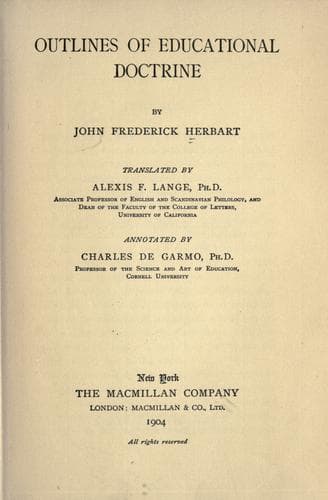
Outlines of Educational DoctrineHerbart, Johann Friedrich
Philosophy
Outlines of Educational Doctrine
Herbart, Johann Friedrich
Education -- Philosophy
It must be noted, also, that instead of being the most difficult, the
most advanced instruction is the easiest of all, because imparted with
the least departure from the way in which it was received. People are
therefore mistaken when they assume that private tutors are capable
of furnishing an equivalent only for the lowest classes in gymnasia. A
far greater difficulty lies in the fact that even the most skilful and
active tutor cannot give as many lessons as a school provides, and that
accordingly more has to be left to the pupil’s own efforts. To be sure,
this is exactly the mode of instruction which suits the bright student
better than one that must accommodate itself to the many, and which on
that account must progress but slowly.
336. But home education presupposes that sound pedagogical views have
been arrived at in the home, and that their place is not occupied
by absurd whims or half knowledge. (Niemeyer’s famous work, “The
Principles of Education and of Instruction,” is intelligible to every
educated person, and has been widely known for many years.)
337. The necessity of sound pedagogical knowledge in the home becomes
all the more urgent where teachers, private or public, change
frequently--whereby inequalities of instruction and treatment are
introduced which need to be corrected.
CHAPTER II
=Concerning Schools=
338. The school system and its relations to local authorities, on the
one hand, and to the general government, on the other, form a vast and
difficult subject involving not merely pedagogical principles, but also
such aims as the maintenance of higher learning, the dissemination
of useful information, and the practice of indispensable arts. In
university lectures a few words on such topics suffice, since young
men who accept a school position assume, at the same time, obligations
which for a long time to come prescribe for them the path they must
follow.
339. They must, in the first place, consider the character of the
school in which they are to instruct. The school programme provides
them with information concerning the scope of the curriculum, the
established relations of the branches of instruction to one another,
and the various stages in each subject. The teachers’ conference
affords them an insight into multiplex relations to authorities,
parents, and guardians, and to the pupils, also relations leading to
coöperation, more or less perfect, on the part of the teachers. The
whole of the educational effort directed upon younger, intermediate,
and older pupils is presented in one view; it is known also where the
pupils come from, with what kind of preparation, and where as a rule
they go upon leaving the school.
Public-domain text, read in full here on John Shaqi.
Reviews
Reviews
No reviews yet
Be the first to share your thoughts on this work.
Elsewhere in the archive
Join the Discussion
Join the discussion
Sign in to leave a comment or review.
Sign InorCreate an account