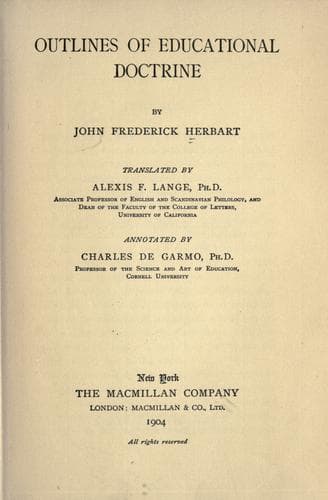
Outlines of Educational DoctrineHerbart, Johann Friedrich
Philosophy
Outlines of Educational Doctrine
Herbart, Johann Friedrich
Education -- Philosophy
340. It must obviously make a vast difference whether pupils look
forward to the university, or whether the gymnasium is filled with boys
who do not intend to pursue higher studies; whether a burgher school
sets a final examination to mark the stage of general culture to which
the school is expected to advance the pupils, or whether the pupils
enter and leave without well-defined reasons according to what seems
best to their respective families; whether an elementary school is
conducted merely as an institution preparing for gymnasia or burgher
schools, or whether its course provides for the suitable education,
during his whole boyhood, of the future artisan, etc.
The American school system possesses this great advantage over that
of Germany,--it has an educational ladder planted in every elementary
school upon which any child from any social class may mount as high as
his ambition incites, or his means and ability permit. It is the only
suitable system in a democracy, where opportunity should be open to
all. Even to obtain greater perfection than the German school system
has ever attained, a democratic nation cannot afford to impair its
present organization, in so far as it makes advancement possible to
every aspiring soul.
341. In each case the official activity entered upon must adjust itself
properly to the whole, the outlines of which are given. These determine
the proportion and the subdivision of the store of learning to be kept
ready for use, the degree of confidence to be shown to pupils as to
knowledge already acquired, and the manner in which they are to be
addressed. It is important that the teacher should appear before his
class adequately prepared and with confident self-possession, that he
should look about attentively at every one and make each pupil feel at
once that it would not be easy for him to undertake anything without
being noticed.
342. The questions to be put to the pupils need to be formulated
clearly and concisely, and they must follow each other in easy
sequence. The answers must be corrected and, when necessary, repeated,
in order that all may hear them. No pause should be unduly prolonged;
no explanation to the weaker pupil should be allowed to become
oppressively tedious to the more advanced. Those who are at work
at the moment must be assisted, but ought not to be disturbed by
much interrupting talk. The current of thought is to be invited and
accelerated in all, but not hurried, etc.
Such requirements instruction will meet with greater or less
difficulty, according as classes are small or large and the inequality
of pupils great or slight.
343. In the assigning of work the capacity of each pupil must be taken
into account as much as possible, in order that no one may surrender to
ill-humor and discouragement on account of excessive demands, nor any
one permit himself carelessly to abuse a task too easy for him.
Public-domain text, read in full here on John Shaqi.
Reviews
Reviews
No reviews yet
Be the first to share your thoughts on this work.
Elsewhere in the archive
Join the Discussion
Join the discussion
Sign in to leave a comment or review.
Sign InorCreate an account