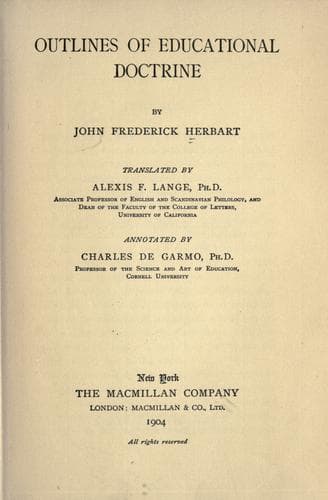
Outlines of Educational DoctrineHerbart, Johann Friedrich
Philosophy
Outlines of Educational Doctrine
Herbart, Johann Friedrich
Education -- Philosophy
344. Inequalities of division resulting from rearrangements of classes,
or other changes, must be pointed out to the authorities as clearly
as possible, for the purpose of urging a more even distribution and a
reduction of excessive numbers.
345. In the course of the gradual extension of such efforts many a
defect will come to light. It may be found, for instance, that the
school is not a whole, because of the lack of a competent teacher for
an important subject, or because of marked inequalities of knowledge
and culture due to the preparatory schools, or because the school (such
as those in small towns) follows the curriculum of a gymnasium while
its real aim is supposed to be that of a burgher school, etc.
346. Reports of such single defects will as a rule lead only to
correspondingly partial improvements in the system and to relief from
the most onerous perplexities, since it is seldom found possible to
organize the system of a whole province at once in such a way as to
make one harmonious whole.
347. But in case comprehensive reforms of the school system were
undertaken, it would be necessary not merely to tolerate great
multiformity, but even to create it purposely. For division of labor
is in all human performance the right path to better things; and the
preceding discussion must have shown with sufficient clearness how much
depends on a more discriminating segregation of pupils.
INDEX
A, B, C, of Perception, 253.
Absorption and Reflection, 66.
Action, clandestine, 315.
Action and Rest, 156.
Administrative System, 15.
Adolescence, and obedience, 161;
bibliography for, 231.
Æsthetics, 93.
Affection, 24.
Algebra, history of, 255.
Alertness of mind, superficial, 301.
American History _vs._ that of Greece and Rome, 241.
Analytic instruction, definition, 106;
first stages of, 111;
other forms of, 117;
with children, 214.
Ancient Languages, their use as employment, 98;
labor of mastering, 103.
Apperceiving attention, capacity for, 129.
Application, 67;
a stage of method, 70.
Approbation, 151.
Arguing with children, evils of, 164.
Arithmetic, with boys, 223–224.
Arranging of objects, 215.
Arrested development, 171.
Art of narration, 76.
Arts, 251.
Assistance, gradual withdrawal, 204.
Association, 67;
promoted by conversation, 69.
Athletics, over-valuation of, 169.
Attention, divided, 63;
forced and spontaneous, 73;
primitive and apperceiving, 74.
Authority, 53–163;
delegated, 319.
Aversion, 24.
Bad conduct of adults, 187.
Baldwin, quoted, 168, 195.
Barrenness of text-book method, 243.
Barriers to education, 5.
Bennett and Bristol, “The teaching of Latin and Greek,” 279.
Bible stories, 234.
Biblical stories _vs._ Mythology, 237.
Boundary between boyhood and adolescence, 217.
Boyhood, boundary between, and adolescence, 217.
Brown, George P., 271.
Public-domain text, read in full here on John Shaqi.
Reviews
Reviews
No reviews yet
Be the first to share your thoughts on this work.
Elsewhere in the archive
Join the Discussion
Join the discussion
Sign in to leave a comment or review.
Sign InorCreate an account