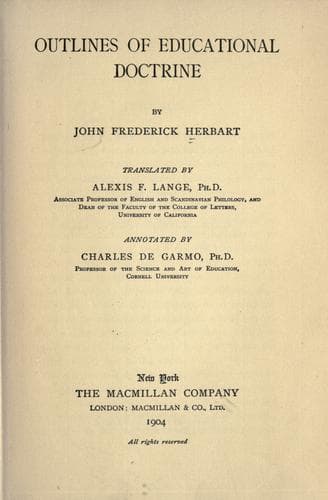
Outlines of Educational DoctrineHerbart, Johann Friedrich
Philosophy
Outlines of Educational Doctrine
Herbart, Johann Friedrich
Education -- Philosophy
Ease of government, 54.
Easy before the difficult, 127.
Eckoff, Wm. J., 254.
Educability of pupils, 1.
Education according to age, 195–231;
first three years, 195–202;
from four to eight, 203–216;
boyhood, 217–226;
youth, 227–231.
Education as home task, 333.
Educational bookkeeping, 50.
Educative instruction, 59, 100;
value in fixing curriculum, 100.
Election, basis of, 65.
Electives, 89.
Elevation and depression, 156.
Employment, the foundation of government, 46;
for children, 56.
Endurance, 154.
English schools, effect on character of boys, 183.
Environment, influence of, 5, 55;
of pupils, 94.
Equilibrium of ideas, 75.
Equity, definition, 13.
Erratic mental movements, 302.
Estrangement and its removal, 66.
Ethical Basis of Pedagogics, 8–19.
Ethical judgment, 25.
Ethical life, range of, 292.
Ethics, the goal of education, 2.
Examination _vs._ review, 117.
Experience, limits of, 110.
Explication, 67.
Expulsion, 52.
Evil, exclusion of, 149.
Faculties, 20, 21, 22, 23;
names for, 27.
Family, its interest in the individual, 288;
its lack of vigor, 333.
Fatalism, 1, 3.
Fatigue, produced by instruction, 70.
Favoritism, 184.
Faults of children and their treatment, 294–329;
general differentiation, 294–303;
sources of moral weakness, 304–313;
effects of training upon, 314–319;
special faults, 320–329;
habitual, 326;
minor, 321;
committed _vs._ faults possessed, 320.
Faust, 83.
First offences, treatment of, 323.
Fiske, method of using text-books of history, 247.
“Five windows of the Soul,” 37.
Fixation of ideas, premature, 218.
Formal Culture, Dogma of, Hinsdale, 279.
Formal steps, 67.
Frankness, lack of, 26;
need of, 322.
Freedom and restraint, 156.
Friendliness, with children, 211.
Games, the supervision of, 178;
coöperative, 178.
General notions, definition, 30.
Generalizations, 92.
Gentle measures, 43.
Geography, 263–268;
home geography, 263;
an associating science, 264;
narration in, 265;
the old _vs._ the new, 266;
reviews in, 267.
Geographical aspects of history, 245.
Geographical _vs._ historical studies, 293.
Geometry, advantages of association, 102.
Good will, definition, 11;
in children, 206;
two aspects of, 185.
Golden rule, 148.
Goldsmith on the moody teacher, 166.
Government of children, 45–55.
Grading, 344–345.
Grammar, amount to be given, 130.
Greek and Latin, 277–285;
time for beginning, 277–278;
manner of teaching, 279.
Greek and Roman history, priority of, 246;
_vs._ American history, 246.
Greek, authors to be used, 283;
relation of, to religious impressions, 233.
Groups of ideas, 29.
Gumplowicz, 5.
Gymnastic exercises, excessive, 132.
Public-domain text, read in full here on John Shaqi.
Reviews
Reviews
No reviews yet
Be the first to share your thoughts on this work.
Elsewhere in the archive
Join the Discussion
Join the discussion
Sign in to leave a comment or review.
Sign InorCreate an account