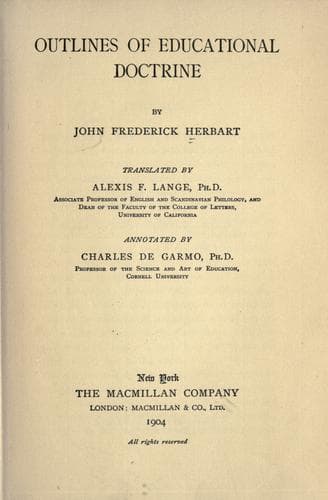
Outlines of Educational DoctrineHerbart, Johann Friedrich
Philosophy
Outlines of Educational Doctrine
Herbart, Johann Friedrich
Education -- Philosophy
Harris, Dr. Wm. T., 37, 143.
Harmony of insight and volition, 9.
Heavenly bodies, observation of, 259.
Herbert Spencer, 85, 157.
Herodotus, stories of, 243.
Higher education, the comparative study of branches, 89.
Higher _vs._ lower schools, 340.
High school, six-year course in, 103.
Hinsdale, “Dogma of Formal Culture,” 279.
History, 239–251;
prevailing error of young teachers of, 239;
American _vs._ Greek and Roman, 241;
mediæval, 249;
modern, 250.
Historical instruction, a branch of education, 37.
Home education, 330–337.
Home work, not a saving of labor, 123.
Homogeneity of pupils, 112.
Honor, standards of, 169;
a feeling of, 223.
_Humaniora_ _vs._ _realia_, 99.
Ideas, groups of, 29;
their source, 36;
equilibrium of, 75;
degree of strength, 102.
“Iliad” and “Odyssey,” 283.
Imaginary and complex numbers, 256.
Imagination, 22.
Incapacity, feeling of, in children, 216.
Inclinations _vs._ principles, 193.
Individuality, modification of, 41;
differences of, 54.
Individual traits, permanency of, 295.
Indolence of youth, 227.
Inequalities, correction of, 60.
Infancy, 195–202.
Inherent faults, 294.
Inner freedom, aspects of, 187.
Instability of ideas, 301.
Instruction, 56–135;
relation to government and training, 56–61;
aim of, 62–65;
conditions of many-sidedness in, 66–70;
conditions determining interest in, 71–82;
as information giving, 35;
and rudeness, 35;
in relation to pupils’ ideas and disposition, 36;
branches of, 36;
its good beginning, 105.
Insertion _vs._ continuation, 129.
Insight, definition, 8;
harmony of with volition, 9.
Intercourse, social, 78.
Interest, conditions of, 71–82;
main kinds of, 83–94;
many-sidedness of, 62;
direct and indirect, 63;
_vs._ effort, 63;
bearing of on virtue, 64;
classification of, 83;
not sole guide to selection of studies, 135;
compared with skill, 289.
Inventions, 251.
Irritability, 297.
James, quoted, 175.
Judgment, 23;
of moral quality of actions, 9;
ethical, 25.
Justice and equality with boys, 221.
Kant, 3;
his views on moral obedience, 173.
Lange’s “Apperception,” 74.
Language lessons _vs._ grammar, 271.
Languages, difficulties of, 129.
Larned, method of using text-books, 247.
Latin and Greek, 277–285;
time for beginning, 103;
composition in, 285.
Latin, increase in study of, 278;
reasons for teaching, 279;
authors to be read, 282.
Letter writing, 276.
Listlessness, 158.
Literary masterpieces, study of, 76.
Logarithms, 254.
Love, 53.
Public-domain text, read in full here on John Shaqi.
Reviews
Reviews
No reviews yet
Be the first to share your thoughts on this work.
Elsewhere in the archive
Join the Discussion
Join the discussion
Sign in to leave a comment or review.
Sign InorCreate an account