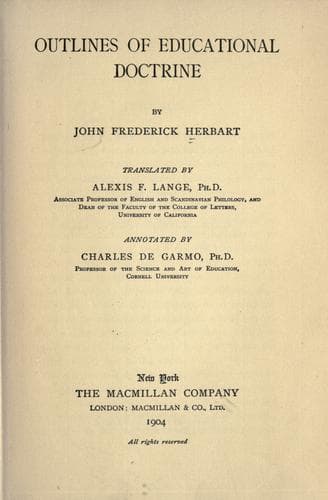
Outlines of Educational DoctrineHerbart, Johann Friedrich
Philosophy
Outlines of Educational Doctrine
Herbart, Johann Friedrich
Education -- Philosophy
Savings banks, 170.
“School and Society,” Dr. John Dewey, 38.
School hygiene, literature of, 132.
Schoolrooms, need for spacious, 132.
Schools, organization of, 338–347.
School system, 338.
Scientific instruction, a branch of education, 37.
Scientific _vs._ classical education, 85.
Seclusion _vs._ society, 168.
Secondary education in United States, its brevity, 103.
Self-activity, 71.
Self-defence, 183.
Self-determination, 26.
Sensibility, kindness of, 152.
Sensual impulses, 298.
Sequence, common view, 96;
of studies, 128.
Series of ideas, 121.
Severity for concealed offences, 316.
Simulation of ethical judgments, 317.
Sin, 338.
Six-year high school course, 103.
Skill _vs._ interest, 289.
Sluggishness of pupils, 165.
Smith, David Eugene, 255, 256.
Social cheerfulness, 211.
Social circle, relation of child to, 208.
Social ends of training, 160.
Social environment of pupils, 94.
Social faults, correction for, 327.
Social intercourse, 78.
Social pressure in government, 161.
Social relations the source of will, 318.
Social, the, in conduct, 62.
Society _vs._ seclusion, 168.
Source of ideas, 36.
Special applications of pedagogics, 232–293;
religion, 232–238;
history, 239–251;
mathematics and natural science, 252–262;
geography, 263–268;
the mother-tongue, 269–275.
Speer, 253.
Spencer, Herbert, 85, 157.
Spinoza, 3.
Spy, the teacher as, 317.
Standards of honor, 169.
State, its attitude toward the individual, 331.
Strife, 182.
Structure of groups of ideas, 31.
Studies, social function of, 62;
as social instruments, 64;
for boys, 225.
Study of literary masterpieces, 76.
Style of speaking, 108.
Subjects to be taught, 100.
Supervision, 48;
strictness of, 49, 50.
Sweetmeats, educational, 99.
Syntax, Latin, 284.
Synthetic instruction, definition, 106;
nature and course of, 125–126.
System, 67;
promoted by connected discourse, 69;
of laws and rewards, 14;
of civilization, 16.
Tardiness, 161.
Teacher as spy, 317.
Teachers’ conferences, 339.
Temperaments, 295.
Temper, violent, 298.
Tests by the state, 332.
Text-book methods, barrenness of, 243.
Text-book _vs._ oral presentation of history, 239.
Themes for composition, 124.
The mob spirit, 168.
The mother-tongue, 269–276.
Thoughtlessness of pupils, 164.
Time, amount to be given to instruction, 132.
Training, 136–194;
definition, 136, 141;
relation to government and instruction, 136–140;
aim of, 141–142;
differentiation of character, 143–147;
differentiation in morality, 148–150;
helps in, 151–159;
general method, 160–194;
blended with government, 140;
function of, 151.
Transfer of pupils, 52.
Translation, difficulty of, for German children, 103.
Trigonometry, 254.
Tutors, place of, 335.
Unification, 65, 66.
Use of things, how taught, 114.
Public-domain text, read in full here on John Shaqi.
Reviews
Reviews
No reviews yet
Be the first to share your thoughts on this work.
Elsewhere in the archive
Join the Discussion
Join the discussion
Sign in to leave a comment or review.
Sign InorCreate an account