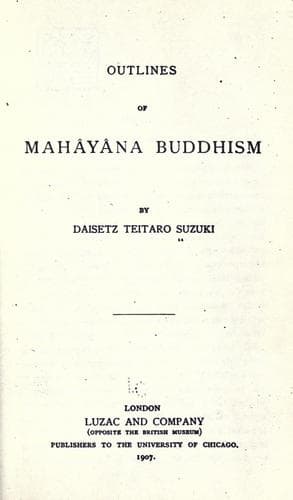
Outlines of Mahayana BuddhismSuzuki, Daisetz Teitaro
Religion
Outlines of Mahayana Buddhism
Suzuki, Daisetz Teitaro
Mahayana Buddhism -- Doctrines
Vulgar people are too eager to see everything and every act they
perform working for the accumulation of earthly wealth and the
promotion of material welfare. They would want to turn even moral
deeds which have no relation to the economic condition of life into
the opportunities to attain things mundane. They would desire to have
the law of karmaic causation applied to a realm, where prevails an
entirely different set of laws. In point of fact, what proceeds from
{191} meritorious deeds is spiritual bliss only,--contentment,
tranquillity of mind, meekness of heart, and immovability of
faith,--all the heavenly treasures which could not be corrupted by
moth or rust. And what more can the karma of good deeds bring to us?
And what more would a man of pious heart desire to gain from his being
good? “Take no thought for your life, what ye shall eat, or what ye
shall drink, nor yet for your body, what ye shall put on. Is not the
life more than meat and the body more than raiment?” Let us then do
away with the worldly interpretation of karma, which is so contrary to
the spirit of Buddhism.
As long as we live under the present state of things, it is impossible
to escape the curse of social injustice and economic inequality. Some
people must be born rich and noble and enjoying a superabundance of
material wealth, while others must be groaning under the unbearable
burden imposed upon them by cruel society. Unless we make a radical
change in our present social organisation, we cannot expect every one
of us to enjoy equal opportunity and fair chance. Unless we have a
certain form of socialism installed which is liberal and rational and
systematic, there must be some who are economically more favored than
others. But this state of affairs is a phenomenon of worldly
institution and is doomed to die away sooner or later. The law of
karma, on the contrary, is an eternal ordinance of the will of the
Dharmakâya as manifested in this world of {192} particulars. We must
not confuse a transient accident of human society with an absolute
decree issued from the world-authority.
_An Individualistic View of Karma._
Public-domain text, read in full here on John Shaqi.
Reviews
Reviews
No reviews yet
Be the first to share your thoughts on this work.
Elsewhere in the archive
Join the Discussion
Join the discussion
Sign in to leave a comment or review.
Sign InorCreate an account