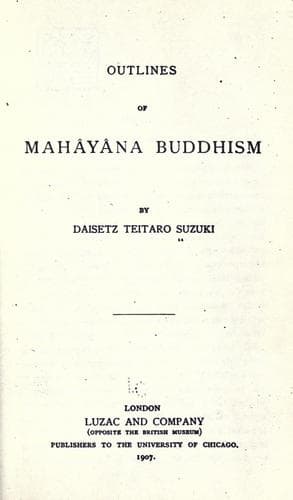
Outlines of Mahayana BuddhismSuzuki, Daisetz Teitaro
Religion
Outlines of Mahayana Buddhism
Suzuki, Daisetz Teitaro
Mahayana Buddhism -- Doctrines
There is another popular misconception concerning the doctrine of
karma, which seriously mars the true interpretation of Buddhism. I
mean by this an individualistic view of the doctrine. This view
asserts that deeds, good or evil, committed by a person determine only
his own fate, no other’s being affected thereby in any possible way,
and that the reason why we should refrain from doing wrong is: for we,
and not others, have to suffer its evil consequences. This conception
of karma which I call individualistic, presupposes the absolute
reality of an individual soul and its continuance as such in a new
corporeal existence which is made possible by its previous karma.
Because an individual soul is here understood as an independent unit,
which stands in no relation to others, and which therefore neither
does influence nor is influenced by them in any wise. All that is done
by oneself is suffered by oneself only and no other people have
anything to do with it, nor do they suffer a whit thereby.
Buddhism, however, does not advocate this individualistic
interpretation of karmaic law, for it is not in accord with the theory
of non-âtman, nor with that of Dharmakâya.
According to the orthodox theory, karma simply means the conservation
or immortality of the inner {193} force of deeds regardless of their
author’s physical identity. Deeds once committed, good or evil, leave
permanent effects on the general system of sentient beings, of which
the actor is merely a component part; and it is not the actor himself
only, but everybody constituting a grand psychic community called
“Dharmadhâtu” (spiritual universe), that suffers or enjoys the outcome
of a moral deed.
Public-domain text, read in full here on John Shaqi.
Reviews
Reviews
No reviews yet
Be the first to share your thoughts on this work.
Elsewhere in the archive
Join the Discussion
Join the discussion
Sign in to leave a comment or review.
Sign InorCreate an account