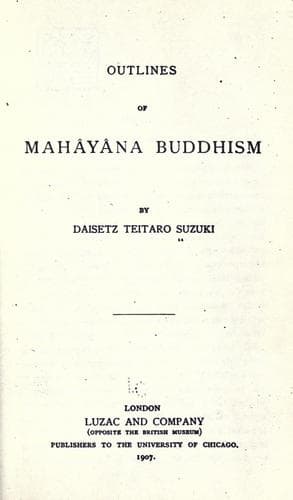
Outlines of Mahayana BuddhismSuzuki, Daisetz Teitaro
Religion
Outlines of Mahayana Buddhism
Suzuki, Daisetz Teitaro
Mahayana Buddhism -- Doctrines
The reason why a moral deed performed by one person would contribute
to the attainment by others of supreme enlightenment, is that souls
which are ordinarily supposed to be individual and independent of
others are not so in fact, but are very closely intermingled with one
another, so that a stir produced in one is sooner or later transmitted
to another influencing it rightfully or wrongfully. The karmaic effect
of my own deed determines not only my own future, but to a not little
extent that of others; hence those invocations just quoted by pious
Buddhists who desire to dedicate all the merits they can attain to the
general welfare of the masses.
The ever-increasing tendency of humanity to widen and facilitate
communication in every possible way is a phenomenon illustrative of
the intrinsic oneness of human souls. Isolation kills, for it is
another name for death. Every soul that lives and grows desires to
embrace others, to be in communion with them, to be supplemented by
them, and to expand infinitely so that all individual souls are
brought together and united in the one soul. Under this condition only
a man’s karma is enabled to influence other people, and his merits can
be utilised for the promotion of general enlightenment.
{196}
_Karma and Determinism._
If the irrefragability of karma means the predetermination of our
moral life, some would reason, the doctrine is fatalism pure and
simple. It is quite true that our present life is the result of the
karma accumulated in our previous existences, and that as long as the
karma preserves its vitality there is no chance whatever to escape its
consequences, good or evil. It is also true that as the meanest
sparrow shall not fall on the ground without the knowledge of God, and
as the very hairs of our heads are all numbered by him, so even a
single blade of grass does not quiver before the evening breeze
without the force of karma. It is also true that if our intellect were
not near-sighted as it is, we could reduce a possible complexity of
the conditions under which our life exists into its simplest terms,
and thus predict with mathematical precision the course of a life
through which it is destined to pass. If we could record all our
previous karma from time immemorial and all its consequences both on
ourselves and on those who come in contact with us, there would be no
difficulty in determining our future life with utmost certainty. The
human intellect, however, as it happens, is incapable of undertaking a
work of such an enormous magnitude, we cannot perceive the full
significance of determinism; but, from the divine point of view,
determinism seems to be perfectly justified, for there cannot be any
short-sightedness on the part of a world-soul as to the destiny of the
universe, which {197} is nothing but its own expression. It is only
from the human point of view that we feel uncertain about our final
disposition and endeavor to explain existence now from a mechanical,
Public-domain text, read in full here on John Shaqi.
Reviews
Reviews
No reviews yet
Be the first to share your thoughts on this work.
Elsewhere in the archive
Join the Discussion
Join the discussion
Sign in to leave a comment or review.
Sign InorCreate an account