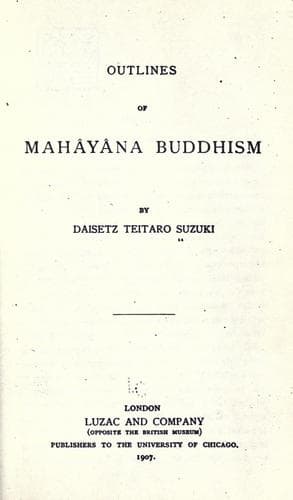
Outlines of Mahayana BuddhismSuzuki, Daisetz Teitaro
Religion
Outlines of Mahayana Buddhism
Suzuki, Daisetz Teitaro
Mahayana Buddhism -- Doctrines
Because the universe is not a theatre for one particular soul only; on
the contrary, it belongs to all sentient beings, each forming a
psychic unit; and these units are so intimately knitted together in
blood and soul that the effects of even apparently trifling deeds
committed by an individual are felt by others just as much and just as
surely as the doer himself. Throw an insignificant piece of stone into
a vast expanse of water, and it will certainly create an almost
endless series of ripples, however imperceptible, that never stop till
they reach the furthest shore. The tremulation thus caused is felt by
the sinking stone as much as the water disturbed. The universe that
may seem to crude observers merely as a system of crass physical
forces is in reality a great spiritual community, and every one of
sentient beings forms its component part. This most complicated, most
subtle, most sensitive, and best organised mass of spiritual atoms
transmits its current of moral electricity from one particle to
another with utmost rapidity and surety. Because this community is at
bottom an expression of one Dharmakâya. However diversified {194} and
dissimilar it may appear in its material individual aspect, it is
after all no more than an evolution of one pervading essence, in which
the multitudinousness of things finds its unity and identity.
Therefore, it is for the interests of the community at large, and not
for their own welfare only, that sincere Buddhists refrain from
transgressing moral laws and are encouraged to promote goodness. Those
whose spiritual insight thus penetrates deep into the inner unity and
interaction of all human souls are called Bodhisattvas.
It is with this spirit, let me repeat, that pious Buddhists do not
wish to keep for themselves any merits created by their acts of love
and benevolence, but wish to turn them over (_parivarta_) to the
deliverance of all sentient creatures from the darkness of ignorance.
The most typical way of concluding any religious treatise by Buddhists,
therefore, runs generally in the following manner:
“The deep significance of the three karmas as taught by Buddha,
I have thus completed elucidating in accord with the Dharma and logic:
By dint of this merit I pray to deliver all sentient beings
And to make them soon attain to perfect enlightenment.”[88]
Or,
“All the merits arising from this my exposition
May abide and be universally distributed among all beings;
And may they ascend in the scale of existence and increase in bliss
and wisdom,
And soon attain to an enlightenment supreme, perfect, great, and
far-reaching.”[89]
{195}
Public-domain text, read in full here on John Shaqi.
Reviews
Reviews
No reviews yet
Be the first to share your thoughts on this work.
Elsewhere in the archive
Join the Discussion
Join the discussion
Sign in to leave a comment or review.
Sign InorCreate an account