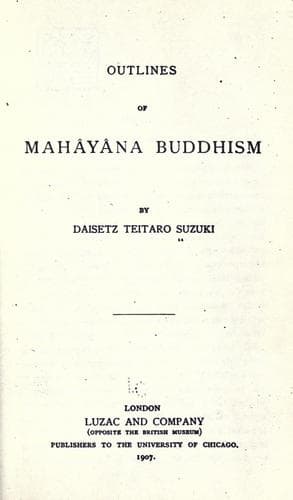
Outlines of Mahayana BuddhismSuzuki, Daisetz Teitaro
Religion
Outlines of Mahayana Buddhism
Suzuki, Daisetz Teitaro
Mahayana Buddhism -- Doctrines
The doctrine of karma is, therefore, really the theory of evolution
and heredity as working in our moral field. As Walt Whitman fitly
sings, in every one of us, “converging objects of the universe” are
perpetually flowing, through every one of us is “afflatus surging and
surging--the current and index.” And these converging objects and this
afflatus are no more than our karma which is interwoven in our being
and which is being matured from the very beginning of consciousness
upon the earth. Each generation either retards or furthers the
maturing of karma and transmits to the succeeding one its stock either
impaired or augmented. Those who are blind enough not to {201} see the
significance of life, those who take their ego for the sole reality,
and those who ignore the spiritual inheritance accumulated from time
immemorial,--are the most worthless, most ungrateful, and most
irresponsible people of the world. Buddhism calls them the children of
Mâra engaged in the work of destruction.
Dr. G. R. Wilson of Scotland states a very pretty story about a royal
robe in his article on “The Sense of Danger” (_The Monist_, 1903,
April), which graphically illustrates how potential karma stored from
time out of mind is saturated in every fibre of our subliminal
consciousness or in the Âlayavijñâna, as Buddhists might say. The
story runs as follows:
“An Oriental robe it was, whose beginning was in a prehistoric dynasty
of which the hieroglyphics are undecipherable. With that pertinacity
and durability so characteristic of the East, this royal garment has
been handed down, not through hundreds of years, but through hundreds
of generations,--generations, some of them, unconsciously long and
stale and dreary; others short and quick and merry. A garment of kings,
this, and of queens, a garment to which, as tradition prescribed, each
monarch added something of quality,--a jewel of price, a patch of
gold, a hem of rich embroidery,--and with each contribution a legend,
worked into the imperishable fibre, told the story of the giver. Did
something of the personality of these kings and queens linger in the
work of their hands? If so, the robe was no dead thing, no mere
covering to be lightly assumed or lightly laid aside, but a living
{202} power, royal influence, and the wearer, all unwitting, must have
taken on something of the character of the dead. It is a princess of
the royal blood, perhaps, sensitive and mystical, trembling on the
apprehensive verge of monarchy, who dons the robe, and as she dons it,
tingles to its message. These great rubies that blaze upon its front
are the souvenirs of bloody conquerors. As she fingers them idly, she
is thrilled with an emotion she does not understand, for in her blood
something answers to the fighting spirit they embody. Pearls are for
peace. That rope has been strung by kings and queens who favored art
and learning; and as the girl’s fingers stray towards them the
Public-domain text, read in full here on John Shaqi.
Reviews
Reviews
No reviews yet
Be the first to share your thoughts on this work.
Elsewhere in the archive
Join the Discussion
Join the discussion
Sign in to leave a comment or review.
Sign InorCreate an account