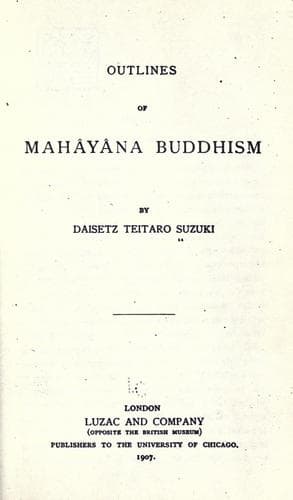
Outlines of Mahayana BuddhismSuzuki, Daisetz Teitaro
Religion
Outlines of Mahayana Buddhism
Suzuki, Daisetz Teitaro
Mahayana Buddhism -- Doctrines
inspiration changes and her mind reverts to the purposes of the
civilised scholar. Here is a gaudy hem, the legacy of an unfaithful
queen, steeped in intrigue all her life until her murder ended it; and
as the maiden lifts it to examine it more closely, she learns with
shame and blushes, yet not knowing what has wrought this change in
her, that, deep down in her character, are mischievous possibilities,
possibilities of wickedness and disgrace that will dog the footsteps
of her reign. Suchlike are the suggestions which the hidden parts of
the mind bring forth, and in such subtle manner are they born.”
The doctrine of karma thus declares that an act of love and good-will
you are performing here is not for your selfish interests, but it
simply means the appreciation of the works of your worthy ancestors
and the discharge of your duties towards {203} all humanity and your
contribution to the world-treasury of moral ideals. Mature good stock,
accumulate merits, purify evil karma, remove the ego-hindrance, and
cultivate love for all beings; and the heavenly gate of Nirvâna will
be opened not only to you, but to the entire world.
We can sing with Walt Whitman the immortality of karma and the eternal
progress of humanity, thus:
“Did you guess anything lived only its moment?
The world does not so exist--no part palpable or impalpable so exist;
No consummation exists without being from some long previous
consummation--and that from some other,
Without the farthest conceivable one coming a bit nearer the beginning
than any.”[90]
_Immortality._
We read in the _Milinda-pañha_:
“Your Majesty, it is as if a man were to ascend to the story of a
house with a light, and eat there; and the light in burning were to
set fire to the thatch; and the thatch in burning were to set fire to
the house; and the house in burning were to set fire to the village;
and the people of the village were to seize him, and say, ‘Why, O man,
did you set fire to the village?’ and he were to say, ‘I did not set
fire to the village. The fire of the lamp by whose light I ate was a
different one from the one which set fire to the village’; {204} and
they, quarreling, were to come to you. Whose cause, Your Majesty,
would you sustain?”
“That of the people of the village, Reverend Sir,” etc.
“And why?”
“Because, in spite of what the man might say, the latter fire sprang
from the former.”
“In exactly the same way, Your Majesty, although the name and form
which is born into the next existence is different from the name and
form which is to end at death, nevertheless, it is sprung from it.
Therefore is one not freed from one’s evil deeds.”
The above is the Buddhist notion of individual identity and its
conservation, which denies the immortality of the ego-soul and upholds
that of karma.
Public-domain text, read in full here on John Shaqi.
Reviews
Reviews
No reviews yet
Be the first to share your thoughts on this work.
Elsewhere in the archive
Join the Discussion
Join the discussion
Sign in to leave a comment or review.
Sign InorCreate an account