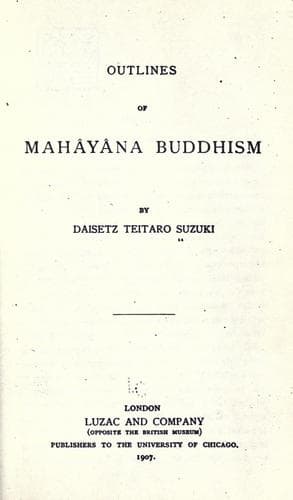
Outlines of Mahayana BuddhismSuzuki, Daisetz Teitaro
Religion
Outlines of Mahayana Buddhism
Suzuki, Daisetz Teitaro
Mahayana Buddhism -- Doctrines
To return to the subject. It does not need any further illustration to
show that all these things which have been said about the family are
also true of the race, the tribe, clan, nation, or any other form of
community. History of mankind in all its manifold aspects of existence
is nothing but a grand drama visualising the Buddhist doctrine of
karmaic immortality. It is like an immense ocean whose boundaries
nobody knows and the waves of events now swelling and surging, now
ebbing, now whirling, now refluxing, in all times, day and night,
illustrate how the laws {208} of karma are at work in this actual
life. One act provokes another and that a third and so on to eternity
without ever losing the chain of karmaic causation.
Next, we come to a form of karma which might be called historical. By
this I mean that a man’s karma can be immortalised by some historical
objects, such as buildings, literary works, productions of art,
implements, or instruments. In fact, almost any object, human or
natural, which, however insignificant in itself, is associated with
the memory of a great man, bears his karma, and transmits it to
posterity.
Everybody is familiar with the facts that all literary work embodies
in itself the author’s soul and spirit, and that posterity can feel
his living presence in the thoughts and sentiments expressed there,
and that whenever the reader draws his inspiration from the work and
actualises it in action, the author and the reader, though corporeally
separate and living in different times, must be said spiritually
feeling the pulsation of one and the same heart. And the same thing is
true of productions of art. When we enter a gallery decorated with the
noble works of Græcean or Roman artists, we feel as if we were
breathing right in the midst of these art-loving people and seem to
reawaken in us the same impressions that were received by them. We
forget, as they did, the reality of our particular existence, we are
unconsciously raised above it, and our imagination is filled with
things not earthly. What a mysterious power it is!--the {209} power by
which those inanimate objects carry us away to a world of ideals! What
a mysterious power it is that reawakens the spirits of by-gone artists
on a sheet of canvas or in a piece of marble! It was not indeed
entirely without truth that primitive or ignorant people intuitively
believed in the spiritual power of idols. What they failed to grasp
was the distinction between the subjective presence of a spirit and
its objective reality. As far as their religious feeling, and not
their critical intellect, was concerned, they were perfectly justified
in believing in idolatry. Taking all in all, these facts unmistakably
testify the Buddhist doctrine of the immortality of karma. A chord of
karma touched by mortals of bygone ages still vibrates in their works,
and the vibration with its full force is transmitted to the sympathetic
souls down to the present day.
Public-domain text, read in full here on John Shaqi.
Reviews
Reviews
No reviews yet
Be the first to share your thoughts on this work.
Elsewhere in the archive
Join the Discussion
Join the discussion
Sign in to leave a comment or review.
Sign InorCreate an account