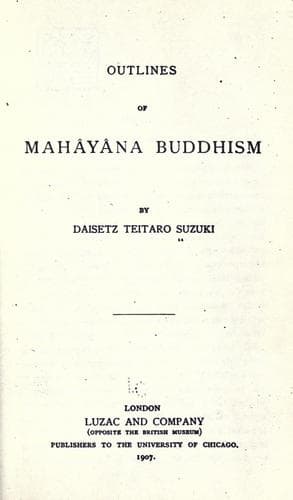
Outlines of Mahayana BuddhismSuzuki, Daisetz Teitaro
Religion
Outlines of Mahayana Buddhism
Suzuki, Daisetz Teitaro
Mahayana Buddhism -- Doctrines
One may be called genealogical, or, perhaps, biological. Suppose here
are descendants of an illustrious family, some of whose ancestors
distinguished themselves by bravery, or benevolence, or intelligence,
or by some other praiseworthy deeds or faculties. These {206} people
are as a rule respected by their neighbors as if their ancestral
spirits were transmitted through generations and still lingering among
their consanguineous successors. Some of them in the line might have
even been below the normal level in their intellect and morals, but
this fact does not altogether nullify the possibility and belief that
others of their family might some day develop the faculties possessed
by the forefathers, dormant as they appear now, through the
inspiration they could get from the noble examples of the past. The
respect they are enjoying and the possibility of inspiration they may
have are all the work of the karma generated by the ancestors. The
author or authors of the noble karma are all gone now, their bones
have long returned to their elements, their ego-souls are no more,
their concrete individual personalities are things of the past; but
their karma is still here and as fresh as it was on the day of its
generation and will so remain till the end of time. If some of them,
on the other hand, left a black record behind them, the evil karma
will tenaciously cling to the history of the family, and the
descendants will have to suffer the curse as long as its vitality is
kept up, no matter how innocent they themselves are.
Here one important thing I wish to note is the mysterious way in which
evil karma works. Evil does not always generate evils only; it very
frequently turns out to be a condition, if not a cause, which will
induce a moral being to overcome it with his {207} utmost spiritual
efforts. His being conscious of the very fact that his family history
is somehow besmirched with dark spots, would rekindle in his heart a
flickering light of goodness. His stock of good karma finally being
brought into maturity, his virtues would then eclipse the evils of the
past and turn a new page before him, which is full of bliss and glory.
Everything in this world, thus, seems to turn to be merely a means for
the final realisation of Good. Buddhists ascribe this spiritual
phenomenon to the virtues of the upâya (expediency) of the Dharmakâya
or Amitâbha Buddha.[91]
Public-domain text, read in full here on John Shaqi.
Reviews
Reviews
No reviews yet
Be the first to share your thoughts on this work.
Elsewhere in the archive
Join the Discussion
Join the discussion
Sign in to leave a comment or review.
Sign InorCreate an account