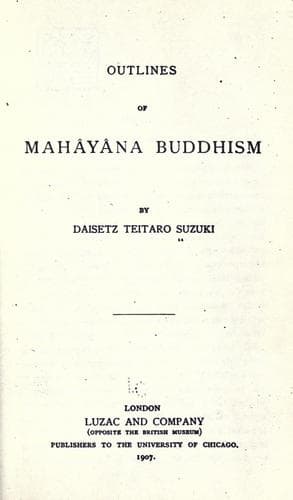
Outlines of Mahayana BuddhismSuzuki, Daisetz Teitaro
Religion
Outlines of Mahayana Buddhism
Suzuki, Daisetz Teitaro
Mahayana Buddhism -- Doctrines
This transformation in the conception of Dharmakâya has been effected
by the different interpretation the term Dharma came to receive from
the hand of the Mahâyânists. Dharma is a very pregnant word and
covers a wide range of meaning. It comes from the root _dhṛ_, which
means “to hold,” “to carry”, “to bear,” and the primitive sense of
dharma was “that which carries or bears or supports,” and then it came
to signify “that which forms the norm, or regulates the course of
things,” that is, “law,” “institution,” “rule,” “doctrine,” then,
“duty,” “justice,” “virtue,” “moral merit,” “character,” “attribute,”
“essential quality,” “substance,” “that which exists,” “reality,”
“being,” etc., etc. The English equivalent most frequently used for
dharma by Oriental scholars is law or doctrine. This may be all right
as far as the Pâli texts go; but when we wish to apply this
interpretation to the Mahâyâna terms, such as Dharmadhâtu, Dharmakâya,
Dharmalakṣa, Dharmaloka, etc., we are placed in an awkward position
and are at a loss how to get at the meaning of those terms. There are
passages in Mahâyâna literature in which the whole significance of the
text depends upon how we understand the word dharma. And it may even
be said that one of the many reasons why Christian students of Buddhism
so frequently fail to recognise the importance of Mahâyânism is due to
their misinterpretation of dharma. Max Mueller, therefore, rightly
remarks in his introduction to an English translation of the
_Vajracchedîka Sûtra_, when he says: “If we {222} were always to
translate dharma by law, it seems to me that the whole drift of our
treatise would become unintelligible.” Not only that particular text
of Mahâyânism, but its entire literature would become utterly
incomprehensible.
In Mahâyânism Dharma means in many cases “thing,” “substance,” or
“being,” or “reality,” both in its particular and in its general
sense, though it is also frequently used in the sense of law or
doctrine. Kâya may be rendered “body,” not in the sense of personality,
but in that of system, unity, and organised form. Dharmakâya, the
combination of dharma and kâya, thus means the organised totality of
things or the principle of cosmic unity, though not as a purely
philosophical concept, but as an object of the religious consciousness.
Throughout this work, however, the original Sanskrit form will be
retained in preference to any English equivalents that have been used
heretofore; for Dharmakâya conveys to the minds of Eastern Buddhists a
peculiar religious flavor, which, when translated by either God or the
All or some abstract philosophical terms, suffers considerably.
_Dharmakâya as Religious Object._
Public-domain text, read in full here on John Shaqi.
Reviews
Reviews
No reviews yet
Be the first to share your thoughts on this work.
Elsewhere in the archive
Join the Discussion
Join the discussion
Sign in to leave a comment or review.
Sign InorCreate an account