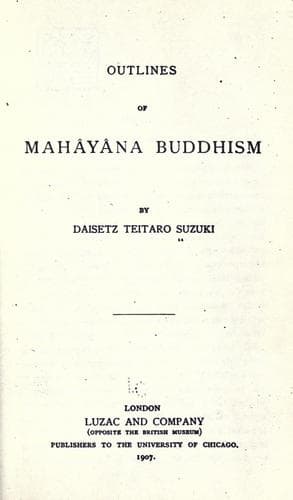
Outlines of Mahayana BuddhismSuzuki, Daisetz Teitaro
Religion
Outlines of Mahayana Buddhism
Suzuki, Daisetz Teitaro
Mahayana Buddhism -- Doctrines
As aforesaid, the Dharmakâya is not a product of philosophical
reflection and is not exactly equivalent to Suchness; it has a
religious signification as the object of the religious consciousness.
The Dharmakâya is a soul, a willing and knowing being, one that is
{223} will and intelligence, thought and action. It is, as understood
by the Mahâyânists, not an abstract metaphysical principle like
Suchness, but it is living spirit, that manifests itself in nature as
well as in thought. The universe as an expression of this spirit is
not a meaningless display of blind forces, nor is it an arena for the
struggle of diverse mechanical powers. Further, Buddhists ascribe to
the Dharmakâya innumerable merits and virtues and an absolute perfect
intelligence, and makes it an inexhaustible fountain-head of love and
compassion; and it is in this that the Dharmakâya finally assumes a
totally different aspect from a mere metaphysical principle, cold and
lifeless.
The _Avatamsaka Sûtra_ gives some comprehensive statements concerning
the nature of the Dharmakâya as follows:
“The Dharmakâya, though manifesting itself in the triple world, is
free from impurities and desires. It unfolds itself here, there, and
everywhere responding to the call of karma. It is not an individual
reality, it is not a false existence, but is universal and pure. It
comes from nowhere, it goes to nowhere; it does not assert itself, nor
is it subject to annihilation. It is forever serene and eternal. It is
the One, devoid of all determinations. This Body of Dharma has no
boundary, no quarters, but is embodied in all bodies. Its freedom or
spontaneity is incomprehensible, its spiritual presence in things
corporeal is incomprehensible. All forms of corporeality are involved
therein, it is able to create all things. Assuming any concrete {224}
material body as required by the nature and condition of karma, it
illuminates all creations. Though it is the treasure of intelligence,
it is void of particularity. There is no place in the universe where
this Body does not prevail. The universe becomes, but this Body
forever remains. It is free from all opposites and contraries, yet it
is working in all things to lead them to Nirvâna.”
_More Detailed Characterisation._
The above gives us a general, concise view as to what the Dharmakâya
is, but let me quote the following more detailed description of it, in
order that we may more clearly and definitely see into the
characteristically Buddhistic conception of the highest being.[92]
“O ye, sons of Buddha! The Tathâgata[93] is not a particular dharma,
nor a particular form of activity, nor has it a particular body, nor
does it abide in a particular place, nor is its work of salvation
confined to one particular people. On the contrary, it involves in
itself infinite dharmas, infinite activities, infinite bodies, infinite
spaces, and universally works for the salvation of all things.
Public-domain text, read in full here on John Shaqi.
Reviews
Reviews
No reviews yet
Be the first to share your thoughts on this work.
Elsewhere in the archive
Join the Discussion
Join the discussion
Sign in to leave a comment or review.
Sign InorCreate an account