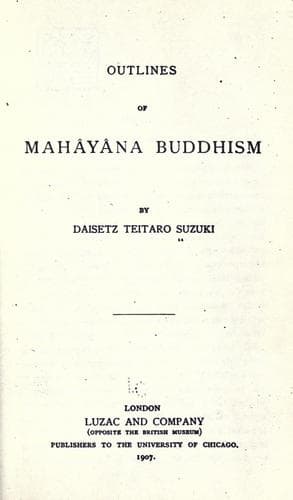
Outlines of Mahayana BuddhismSuzuki, Daisetz Teitaro
Religion
Outlines of Mahayana Buddhism
Suzuki, Daisetz Teitaro
Mahayana Buddhism -- Doctrines
“With one great loving heart
The thirsty desires of all beings he quencheth with coolness
refreshing;
With compassion, of all doth he think,
Which like space knows no bounds;
Over the world’s all creation
With no thought of particularity he revieweth.
“With a great heart compassionate and loving,
All sentient beings by him are embraced;
With means (_upâya_) which are pure, free from stain, and all
excellent,
He doth save and deliver all creatures innumerable.
{234}
“With unfathomable love and with compassion
All creations caressed by him universally;
Yet free from attachment his heart is.
“As his compassion is great and is infinite,
Bliss unearthly on every being he confereth,
And himself showeth all over the universe;
He’ll not rest till all Buddhahood truly attains.”
_Later Mahâyânists’ view of the Dharmakâya._
The above has been quoted almost exclusively from the so-called sûtra
literature of Mahâyâna Buddhism, which is distinguished from the
other religio-philosophical treatises of the school, because the
sûtras are considered to be the accounts of Buddha himself as recorded
by his immediate disciples.[100] Let us now see by way of further
elucidation what views were held concerning the Dharmakâya by such
writers as Asanga, Vasubandhu, etc.
We read in the _General Treatise on Mahâyânism_ by Asanga and
Vasubandhu the following statement:
“When the Bodhisattvas think of the Dharmakâya, how have they to
picture it to themselves?
“Briefly stated, they will think of the Dharmakâya by picturing to
themselves its seven characteristics, which constitute the faultless
virtues and essential {235} functions of the Kâya. (1) Think of the
free, unrivaled, unimpeded activity of the Dharmakâya, which is
manifested in all beings; (2) Think of the eternality of all perfect
virtues in the Dharmakâya; (3) Think of its absolute freedom from all
prejudice, intellectual and affective; (4) Think of those spontaneous
activities that uninterruptedly emanate from the will of the
Dharmakâya; (5) Think of the inexhaustible wealth, spiritual and
physical, stored in the Body of the Dharma; (6) Think of its
intellectual purity which has no stain of onesidedness; (7) Think of
the earthly works achieved for the salvation of all beings by the
Tathâgatas who are reflexes of the Dharmakâya.”
Public-domain text, read in full here on John Shaqi.
Reviews
Reviews
No reviews yet
Be the first to share your thoughts on this work.
Elsewhere in the archive
Join the Discussion
Join the discussion
Sign in to leave a comment or review.
Sign InorCreate an account