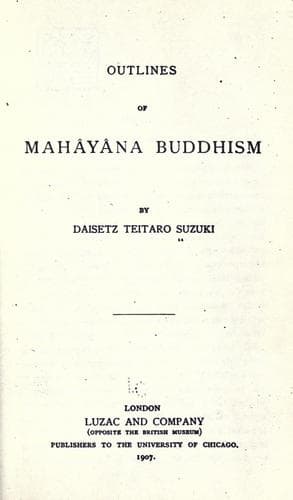
Outlines of Mahayana BuddhismSuzuki, Daisetz Teitaro
Religion
Outlines of Mahayana Buddhism
Suzuki, Daisetz Teitaro
Mahayana Buddhism -- Doctrines
As regards the activity of the Dharmakâya, which is shown in every
Buddha’s work of salvation, Asanga enumerates five forms of operation:
(1) It is shown in his power of removing evils which may befall us in
the course of life, though the Buddha is unable to cure any physical
defects which we may have, such as blindness, deafness, mental
aberration, etc. (2) It is shown in his irresistible spiritual
domination over all evil-doers, who, base as they are, cannot help
doing some good if they ever come in the presence of the Buddha. (3)
It is shown in his power of destroying various unnatural and
irrational methods of salvation which are practiced by followers of
asceticism, hedonism, or Ishvaraism. (4) It is shown in his power of
curing those diseased minds that believe in the reality, permanency,
and indivisibility of the ego-soul, that is, in the pudgalavâda. (5)
It is shown in his inspiring {236} influence over those Bodhisattvas
who have not yet attained to the stage of immovability as well as over
those Çrâvakas whose faith and character are still in a state of
vacillation.
_The Freedom of the Dharmakâya._
Those spiritual influences over all beings of the Dharmakâya through
the enlightened mind of a Buddha, which we have seen above as stated
by Asanga, are fraught with religious significance. According to the
Buddhist view, those spiritual powers everlastingly emanating from the
Body of Dharma have no trace of human elaboration or constrained
effort, but they are a spontaneous overflow from its immanent
necessity, or, as I take it, from its free will. The Dharmakâya does
not make any conscious, struggling efforts to shower upon all sentient
creatures its innumerable merits, benefits, and blessings. If there
were in it any trace of elaboration, that would mean a struggle within
itself of divers tendencies, one trying to gain ascendency over
another. And it is apparent that any struggle and its necessary ally,
compulsion, are incompatible with our conception of the highest
religious reality. Absolute spontaneity and perfect freedom is one of
those necessary attributes which our religious consciousness cannot
help ascribing to its object of reverence. Buddhists therefore
repeatedly affirm that the activity of the Dharmakâya is perfectly
free from all effort and coercion, external and internal. Its every
act of creation or salvation {237} or love emanates from its own free
will, unhampered by any struggling exertion which characterises the
doings of mankind. This free will which is divine, standing in such a
striking contrast with our own “free will” which is human and at best
very much limited, is called by the Buddhists the Dharmakâya’s
“Purvapranidhânabala.”[101]
Public-domain text, read in full here on John Shaqi.
Reviews
Reviews
No reviews yet
Be the first to share your thoughts on this work.
Elsewhere in the archive
Join the Discussion
Join the discussion
Sign in to leave a comment or review.
Sign InorCreate an account