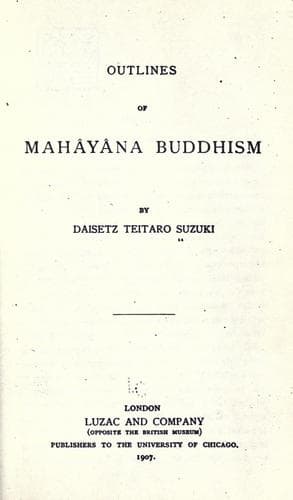
Outlines of Mahayana BuddhismSuzuki, Daisetz Teitaro
Religion
Outlines of Mahayana Buddhism
Suzuki, Daisetz Teitaro
Mahayana Buddhism -- Doctrines
This remark is so absurd that it will at once be rejected by any one
who has a first-hand knowledge of the Mahâyâna system, as even unworthy
of refutation, but Monier-Williams takes special pains to give to his
characterisation of the Mahâyâna doctrine a show of rational
explanation. “Of course,” says he, “men instinctively recoiled from
utter self-annihilation, {19} and so the Buddha’s followers ended in
changing the true idea of Nirvana and converting it from a condition
of non-existence into a state of lazy beatitude in celestial regions
(!), while they encouraged all men--whether monks or laymen--to make a
sense of dreamy bliss in Heaven (!), and not total extinction of life,
the end of all their efforts.” (P. 156.)
This view of the Buddhist heaven as interpreted by Monier-Williams is
nothing but the conception of the Christian heaven colored with
paganism. Nothing is more foreign to Buddhists than this distinguished
Sankritist’s interpretation of celestial existence. The life of devas
(celestial beings) is just as much subject to the law of birth and
death as that of men on earth. What consolation would there be for the
Mahâyânists striving after the highest principle of existence, only
to find themselves transmigrated to a celestial abode, that is also
full of sorrows and sufferings? Always working for the welfare of
their fellow-creatures, the Bodhisattvas never desire any earthly or
heavenly happiness for themselves. Whatever merits, according to the
law of karma, there be stored up for their good work, they do not have
any wish to enjoy them by themselves, but they will have all these
merits turned over (_parivarta_) to the interests of their
fellow-beings. This is the ideal of Bodhisattvas, i.e., of the
followers of Mahâyânism.
{20}
_Beal._
Samuel Beal who is considered by Western scholars to be an authority
on Chinese Buddhism, referring to the Mahâyâna conception of
Dharmakâya,[6] says in his _Buddhism in China_ (p. 156): “We can
have little doubt, then, that from early days worship was offered by
Buddhists at several spots, consecrated by the presence of the Teacher,
to an invisible presence. This presence was formulated by the later
Buddhists under the phrase, ‘the Body of the Law’, Dharmakâya.”
Then, alluding to Buddha’s instruction that says after his Parinirvana
the Law given by him should be regarded as himself, Beal proceeds to
say: “Here was the germ from which proceeded the idea or formula of an
invisible presence: teaching and power of the Law (_Dharma_)
represented the Dharmakâya or Law-Body of Buddha, present with the
order, and fit for reverence.”
Public-domain text, read in full here on John Shaqi.
Reviews
Reviews
No reviews yet
Be the first to share your thoughts on this work.
Join the Discussion
Join the discussion
Sign in to leave a comment or review.
Sign InorCreate an account