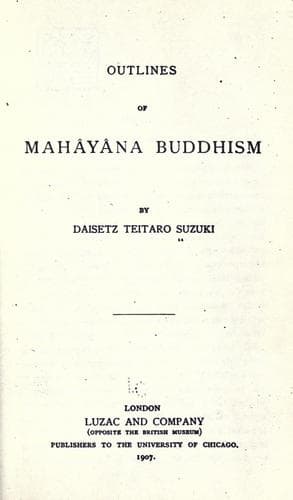
Outlines of Mahayana BuddhismSuzuki, Daisetz Teitaro
Religion
Outlines of Mahayana Buddhism
Suzuki, Daisetz Teitaro
Mahayana Buddhism -- Doctrines
This being the case, we must assume that all the doctrines that are
found in Açvaghoṣa and distinct from those usually held to be
Hînayânistic are the teachings elaborated by Buddhists from the time
of Buddha’s death down to the time of Açvaghoṣa. But as the latter
apparently believes all these doctrines as Buddha’s own and raises no
doubt concerning their later origin, even if they were so, we must
assume again that these doctrines were in a state of completion long
before Açvaghoṣa’s time. If our calculation is correct that he lived
in the first century before Christ, the Mahâyâna faith must be said to
have been formulated at least two hundred years prior to his
age,--taking this presumably as the time that is required for the
formulation and dogmatical establishment of a doctrine. This
calculation places the development of the Mahâyâna faith during the
first century after the Buddha, and, we know, it was during this time
that so many schools and divisions,--among {248} which we must also
find the so-called “primitive” Buddhism of Ceylon, arose among the
Buddhists,--each claiming to be the only authentic transmission of the
Buddha’s teaching. Did Mahâyânism come out of this turmoil of
contention? Did it boldly raise itself from this chaos and claim to
have solved all the questions and doubts that agitated the minds of
Buddhists after the Nirvâna? For certain we do not know anything
concerning the chronology of the development of Buddhist philosophy
and dogmas in India, at least before Açvaghoṣa; but, as far as our
Chinese Buddhist literature records, we must conclude that this was
most probably the case.
To give our readers a glimpse of the state of things that were taking
place in those early days of Buddhism in India, I will quote some
passages from Vasumitra’s _Discourse on the Points of Controversy by
the Different Schools of Buddhism_,--the work once referred to in the
beginning of this book. The two principal schools that arose soon
after the Nirvâna of the Buddha were, as is well known, the Elders
and the Great Council, and though they were further divided into a
number of smaller sections and their views became so complex and
intermixed that some of the Elders shared similar views with the Great
Council School and vice versa, yet we can fairly distinguish one from
the other and describe the essential peculiarities of each school.
These points of difference, generally speaking, are as follows,
confining ourselves to their conceptions about the Buddha:
{249}
Public-domain text, read in full here on John Shaqi.
Reviews
Reviews
No reviews yet
Be the first to share your thoughts on this work.
Elsewhere in the archive
Join the Discussion
Join the discussion
Sign in to leave a comment or review.
Sign InorCreate an account