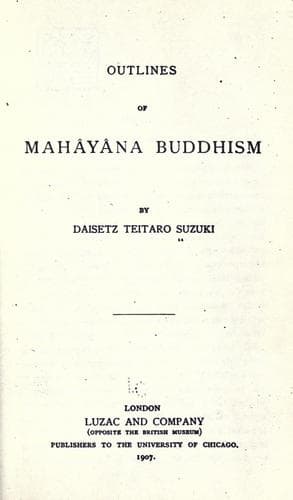
Outlines of Mahayana BuddhismSuzuki, Daisetz Teitaro
Religion
Outlines of Mahayana Buddhism
Suzuki, Daisetz Teitaro
Mahayana Buddhism -- Doctrines
(1) According to the School of the Great Council, the Buddha’s
personality is transcendental (_lokottara_), and all the Tathâgatas
are free from the defilements that might come from the material
existence (_bhâva-âçrava_).[107] For in the Buddha all evil passions
hereditary and acquired were eternally uprooted, and his presence on
earth was absolutely spotless. (_The Vibhaṣa_, CLXXIII.) Contending
this view, the Elders held that the Buddha’s personality was not free
from Bhâvâçrava, though his mind was fully enlightened. His corporeal
existence was the product of blind love veiled with ignorance and
tangled with attachment. If this were not so, the Buddha’s feature
would not have awakened an impure affection in the heart of a maiden,
an ill-will in the heart of a highwayman, stupidity in the mind of an
ascetic, and arrogance in that of a haughty Brahman. These incidents
which {250} happened during the life of the Buddha evince that his
corporeal presence was apt to agitate others’ hearts, and to that
extent it was contaminated by Bhâvâçrava.
(2) The Great Council School insists that every word uttered by a
Tathâgata has a religious, spiritual meaning and purports to the
edification of his fellow-beings; that his one utterance is variously
interpreted by his audience each according to his own disposition, but
all to his spiritual welfare; that every instruction given out by the
Buddha is rational and perfect. Against these views the Elders think
that the Buddha occasionally uttered things which had nothing to do
with the enlightenment of others; that even with the Buddha something
was out of his attainment, for instance, he could not make every one
of his hearers perfectly understand his preachings; that though the
Buddha never taught anything irrational and heretical, yet all his
speeches were not perfect, he said some things which had no concern
with rationality or orthodoxy.
(3) The corporeal body (_rûpakâya_) of the Buddha has no limits
(_koṭi_); his majestic power has no limits; every Buddha’s life is
unlimited; a Buddha knows no fatigue, knows not when to rest, always
occupying himself with the enlightenment of all sentient beings and
with the awakening in their hearts of pure faith. Against these
tendencies of the Great Council School to deify the historical Buddha,
the Elders generally insist on the humanity of Buddhahood. Though the
{251} Elders agree with the Great Council in that the body assumed by
the Buddha as the result of his untiring accumulation of good karma
through eons of his successive existences possesses a wonderful power,
spiritual and material, they do not conceive it to be beyond all
limitations.
(4) The Great Council School says that with the Buddha sleep is not
necessary and he has no dreams. The Elders admit that the Buddha never
dreams, but denies that he does not need any sleep.
Public-domain text, read in full here on John Shaqi.
Reviews
Reviews
No reviews yet
Be the first to share your thoughts on this work.
Elsewhere in the archive
Join the Discussion
Join the discussion
Sign in to leave a comment or review.
Sign InorCreate an account