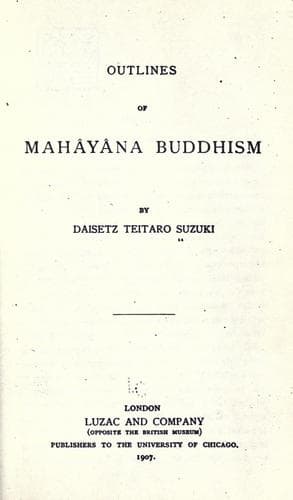
Outlines of Mahayana BuddhismSuzuki, Daisetz Teitaro
Religion
Outlines of Mahayana Buddhism
Suzuki, Daisetz Teitaro
Mahayana Buddhism -- Doctrines
(5) As the Buddha is always in the state of a deep, exalted spiritual
meditation, it is not necessary for him to think what to say when
requested to answer certain questions. Though he might appear to the
inquirers as if he thoroughly cogitates over the problems presented to
him for solution, the Buddha’s response is in fact immediate and
without any efforts. The Elders, on the other hand, presume the
Buddha’s mental calculation as to how to express his ideas as best
suited to the understanding of the audience. Indeed, he does not
cogitate over the problem itself, for with him everything is
transparent, but he thinks over the best method of presenting his
ideas before his pupils.[108]
{252}
Now to return to the doctrine of Dharmakâya and Trikâya. When we
consider these controversies as above stated, it is apparent that
among many other questions which arose soon after the demise of the
Buddha Çâkyamuni, there was one, which in all probability most
agitated the minds of his disciples. I mean the question of the
personality of Buddha. Was he merely a human being like ourselves?
Then, how could he reach such a height of moral perfection? Or was he
a divine being? But Buddha himself did not communicate anything to his
disciples concerning his divinity, nor did he tell them to accept the
Dharma on account of his divine personality, but solely for the sake
of truth. But for all that how could the disciples ever eradicate from
their hearts the feeling of sacred reverence for their teacher, which
was so indelibly engraved there? Whenever they recalled the sermons,
anecdotes, or gâthâs of their master, the truth and spirit embodied
in them and the author must have become so closely associated that
they could not but ask themselves: “What in the Buddha caused him to
perceive and declare these solemn profound truths? What was it that
formed in him such a noble majestic character? What was there in the
mind of Buddha that raised him to such a perfection of intellectual
and religious life? How was it possible that, possessed of such
exalted moral and spiritual virtues, Buddha too had to succumb to the
law of birth and death that is the lot of common mortals?” Some such
questions must have been repeatedly asked before they {253} could
answer them by the doctrines of Dharmakâya and Trikâya.
_Who was the Buddha?_
The evidence that these questions were constantly disturbing the minds
of the disciples ever since the Master’s entrance into Parinirvâna,
is scatteringly revealed throughout the Buddhist texts both Southern
and Northern. The regret of the immediate followers that they did not
ask the Buddha to prolong his earthly life, while the Buddha told them
that he could do so if he wished, and their lamentation over the
remains of the Blessed One, “How soon the Light of the World has
passed away!”[109]--these utterances may be considered the first
drops foreboding the showers of doubt and speculation as to his
personality.
Public-domain text, read in full here on John Shaqi.
Reviews
Reviews
No reviews yet
Be the first to share your thoughts on this work.
Elsewhere in the archive
Join the Discussion
Join the discussion
Sign in to leave a comment or review.
Sign InorCreate an account