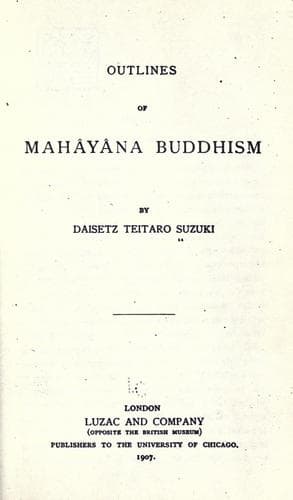
Outlines of Mahayana BuddhismSuzuki, Daisetz Teitaro
Religion
Outlines of Mahayana Buddhism
Suzuki, Daisetz Teitaro
Mahayana Buddhism -- Doctrines
To sum up, the Buddha in the Pâli scriptures was a human being, though
occasionally he is credited to have achieved things supernatural and
superhuman. His historical career began with the abandonment of a
royal life, then the wandering in the wilderness, and a long earnest
meditation on the great problems of birth-and-death, and his final
enlightenment under the Bodhi tree, then his fifty years’ religious
peregrination along the valleys of the Ganges, and the establishment
of a religious system known as Buddhism, and finally his eternal
entrance into the “Parinirvâna that leaves nothing behind”
(_anupadhiçeṣanirvâna_). And as far as plain historical facts are
concerned, these seem to exhaust the life of Çâkyamuni on earth. But
the deep reverence which was felt by his disciples could not be
satisfied with this prosaic humanness of their master and made him
something more than a mortal soul. So even the Pâli tradition gives
him a supramundane life besides the earthly one. He is supposed to
have been a Bodhisattva in the Tuṣita heaven before his entrance into
the womb of Mâyâdevî. The honor of Bodhisattvahood was acceded to him
on account of his deeds of self-sacrifice which were praised throughout
his innumerable past incarnations. While he was walking {271} among us
in the flesh, he was glorified with the thirty-two major and eighty
minor excellent characteristics of a great man.[117] But he was not
the first Buddha that walked on earth to teach the Dharma, for there
were already seven Buddhas before him, nor was he the last one that
would appear among us, for {272} a Bodhisattva by the name of Maitreya
is now in heaven and making preparations for the attainment of
Buddhahood in time to come. But here stopped the Pâli writers, they
did not venture to make any further speculation on the nature of
Buddhahood. Their religious yearnings did not spur them to a higher
flight of the imagination. They recited simple sûtras or gâthâs,
observed the çilas (moral precepts) as strictly and literally as they
could, and thought the spirit of their Master still alive in these
instructions;--let alone the personality of the Tathâgata.
Public-domain text, read in full here on John Shaqi.
Reviews
Reviews
No reviews yet
Be the first to share your thoughts on this work.
Elsewhere in the archive
Join the Discussion
Join the discussion
Sign in to leave a comment or review.
Sign InorCreate an account