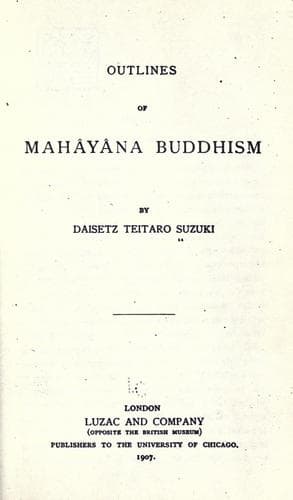
Outlines of Mahayana BuddhismSuzuki, Daisetz Teitaro
Religion
Outlines of Mahayana Buddhism
Suzuki, Daisetz Teitaro
Mahayana Buddhism -- Doctrines
But there was at the same time another group of the disciples of the
Buddha, whose religious and intellectual inclinations were not of the
same type as their fellow-believers; and on that account a simple
faith in the Buddha as present in his teachings did not quite satisfy
them. They perhaps reasoned in this fashion: “If there were seven
Buddhas before the advent of the Great Muni of Çakya and there would
be one more who is to come, where, let us ask, did they derive their
authority and knowledge to preach? How is it that there cannot be any
more Buddhas, that they do not come to us much oftener? If they were
human beings like ourselves, why not we ourselves be Buddhas?” These
questions, when logically carried out, naturally led them to the
theory of Dharmakâya, that all the past Buddhas, and those to come,
and even we ordinary mortals made of clay and doomed to die soon, owe
the raison d’être of their existence to the Dharmakâya, which alone
is immortal in us {273} as well as in Buddhas. The first religious
effort we have to make is, therefore, to recognise this archetype of
all Buddhas and all beings. But the Dharmakâya as such is too abstract
for the average mind to become the object of its religious
consciousness; so they personified or rather materialised it. In other
words, they idealised Çâkyamuni, endowed him not only with the
physical signs (_lakṣas_) of greatness as in the Pâli scriptures,
but with those of celestial transfiguration, and called him a Body of
Bliss of the Tathâgata; while the historical human Buddha was called
a Body of Transformation and all sentient beings Bodhisattvas, that
is, beings of intelligence destined to become Buddhas.
This idealised Buddha, or, what is the same thing, a personified
Dharmakâya, according to the Mahâyâna Buddhists, not only revealed
himself in the particular person of Siddhârtha Gautama in Central
Asia a few thousand years ago, but is revealing himself in all times
and all places. There is no specially favored spot on the earth where
only the Buddha makes his appearance; from the zenith of Akaniṣta
heaven down to the bottom of Nâraka, he is manifesting uninterruptedly
and unintermittently and is working out his ideas, of which, however,
our limited understanding is unable to have an adequate knowledge. The
_Avatamsaka Sûtra_ (Buddhabhadra’s translation, fas. 45, chap. 34)
describes how the Buddha works out his scheme of salvation in all
possible ways. (See also the _Saddharma_ {274} _pundarîka_, Kern’s
translation, chap. 2, p. 30 et seq., and also pp. 413-411.).
Public-domain text, read in full here on John Shaqi.
Reviews
Reviews
No reviews yet
Be the first to share your thoughts on this work.
Elsewhere in the archive
Join the Discussion
Join the discussion
Sign in to leave a comment or review.
Sign InorCreate an account