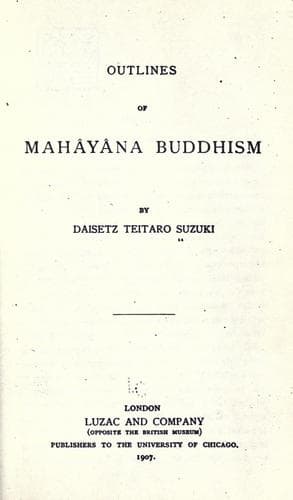
Outlines of Mahayana BuddhismSuzuki, Daisetz Teitaro
Religion
Outlines of Mahayana Buddhism
Suzuki, Daisetz Teitaro
Mahayana Buddhism -- Doctrines
The Mahâyânists wanted to go even beyond the attainment of Arhatship,
however exalted its spirituality may be. They wanted to make every
humble soul {289} a being like Çâkyamuni, they wanted lavishly to
distribute the bliss of enlightenment; they wanted to remove all the
barriers that were supposed to lie between Buddhahood and the common
humanity. But how could they do this when the iron hands of karma held
tight the fate of each individual! How was it possible for him to
identify his being with the ideal of mankind? Perhaps this serious
problem could not very well be solved by Buddhists, when their memory
of the majestic personality of Çâkyamuni was still vivid before their
mental eyes. It was probably no easy task for them to overcome the
feeling of awe and reverence which was so deeply engraved in their
hearts, and to raise themselves to such a height as reached by their
Master, even ideally. This was certainly an act of sacrilege. But, as
time advances, the personal recollection of the Master would naturally
wane and would not play so much influence as their own religious
consciousness which is ever fresh and active. Generally speaking, all
great historical characters that command the reverence and awe of
posterity do so only when their words or acts or both unravel the
deepest secrets of the human heart. And this feeling of awe and
reverence and even of worship is not due so much to the great
characters themselves as to the worshiper’s own religious
consciousness. History passes, but the heart persists. An individual
called Çâkyamuni may be forgotten in the course of time, but the
sacred chord in the inmost heart struck by him reverberates through
eternity. So with the Mahâyâna Buddhists, {290} the religious sentiment
at last asserted itself in spite of the personal recollection and
reverential feeling for the Master. And perhaps in the following way
was the reasoning then advanced by them relative to the great problem
of Buddhahood.
_We are all Bodhisattvas._
As Çâkyamuni was a Bodhisattva in his former lives destined to become
a Buddha, so we are all Bodhisattvas and even Buddhas in a certain
sense, when we understand that all sentient beings, the Buddha not
excepted, are one in the Dharmakâya. The Dharmakâya manifests in us as
Bodhi which is the essence of Buddhas as well as of Bodhisattvas. This
Bodhi can suffer no change whatever in quantity even when the
Bodhisattva attains finally to the highest human perfection as
Çâkyamuni Buddha. In this spirit, therefore, the Buddha exclaimed when
he obtained enlightenment, “It is marvelous indeed that all beings
animate and inanimate universally partake of the nature of
Tathâgatahood.” The only difference between a Buddha and the ignorant
masses is that the latter do not make manifest in them the glory of
Bodhi.
Public-domain text, read in full here on John Shaqi.
Reviews
Reviews
No reviews yet
Be the first to share your thoughts on this work.
Elsewhere in the archive
Join the Discussion
Join the discussion
Sign in to leave a comment or review.
Sign InorCreate an account