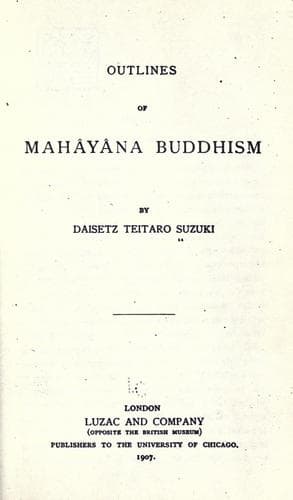
Outlines of Mahayana BuddhismSuzuki, Daisetz Teitaro
Religion
Outlines of Mahayana Buddhism
Suzuki, Daisetz Teitaro
Mahayana Buddhism -- Doctrines
They only are not Bodhisattvas who, enveloped in the divine rays of
light in a celestial abode, philosophically review the world of
tribulations. Even we mortals made of dust are Bodhisattvas,
incarnates of the Bodhi, capable of being united in the all-embracing
love of the Dharmakâya and also of obliterating the {291} individual
curse of karma in the eternal and absolute intelligence of the
Dharmakâya. As soon as we come to live in this love and intelligence,
individual existences are no hindrance to the turning over
(_parivarta_) of one’s spiritual merits (_punya_) to the service of
others. Let us only have an insight into the spirituality of our
existence and we are all Bodhisattvas and Buddhas. Let us abandon the
selfish thought of entering into Nirvana that is conceived to
extinguish the fire of heart and leave only the cold ashes of
intellect. Let us have sympathy for all suffering beings and turn over
all our merits, however small, to their benefit and happiness. For in
this way we are all made the Bodhisattvas.[123]
_The Buddha’s Life._
This spirit of universal love prevails in all Mahâyâna literature,
and the Bodhisattvas are everywhere represented as exercising it with
utmost energy. The Mahâyânists, therefore, could not rest satisfied
with a simple, prosaic, and earthly account of Çâkyamuni, {292} they
wanted to make it as ideal and poetic as possible, illustrating the
gospel of love, as was conceived by them, in every phase of the life
of the Buddha.
The Mahâyânists first placed the Buddha in the Tuṣita heaven before
his birth, (as was done by the Hînayânists), made him feel pity for
the distressed world below, made him resolve to deliver it from “the
ocean of misery which throws up sickness as its foam, tossing with the
waves of old age, and rushing with the dreadful onflow of death,” and
after his Parinirvana, they made him abide forever on the peak of the
Mount Vulture delivering the sermon of immortality to a great
assemblage of spiritual beings. In this wise, they explained the
significance of the appearance of Çâkyamuni on earth, which was
nothing but a practical demonstration of the “Great Loving Heart”
(_mahâkarunâcitta_).
_The Bodhisattva and Love._
Nâgârjuna in his work on the _Bodhicitta_[124] elucidates the
Mahâyânist notion of Bodhisattvahood as follows:
“Thus the essential nature of all Bodhisattvas is a great loving heart
(_mahâkarunâcitta_), and all sentient beings constitute the object
of its love. Therefore, all the Bodhisattvas do not cling to the
blissful taste {293} that is produced by the divers modes of mental
tranquilisation (_dhyâna_), do not covet the fruit of their
meritorious deeds, which may heighten their own happiness.
“Their spiritual state is higher than that of the Çrâvakas, for they
do not leave all sentient beings behind them [as the Çrâvakas do].
They practise altruism, they seek the fruit of Buddha-knowledge
[instead of Çrâvaka-knowledge].
Public-domain text, read in full here on John Shaqi.
Reviews
Reviews
No reviews yet
Be the first to share your thoughts on this work.
Elsewhere in the archive
Join the Discussion
Join the discussion
Sign in to leave a comment or review.
Sign InorCreate an account