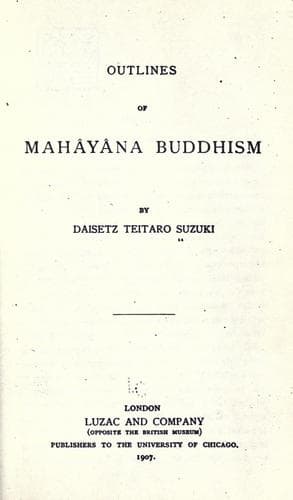
Outlines of Mahayana BuddhismSuzuki, Daisetz Teitaro
Religion
Outlines of Mahayana Buddhism
Suzuki, Daisetz Teitaro
Mahayana Buddhism -- Doctrines
Bodhi, according to the Mahâyânists, is an expression of the
Dharmakâya in the human consciousness. Philosophically speaking,
Suchness or Bhûtatathâtâ is an ontological term, and Dharmakâya or
Tathâgata or Buddha bears a religious significance; while all these
three, Bodhi, Bhûtatathâtâ, and Dharmakâya, and their synonyms are
nothing but different aspects of one and the same reality refracting
through the several defective lenses of a finite intellect.
Bodhi, though essentially an epistemological term, assumes a
psychological sense when it is used in conjunction with citta, i.e.
heart or soul. Bodhicitta, or Bodhihṛdaya which means the same thing,
is more generally used than Bodhi singly in the Mahâyâna texts,
especially when its religious import is emphasised above its
intellectual one. Bodhicitta, viz. intelligence-heart is a reflex in
the human heart of its religious archetype, the Dharmakâya.
Bodhicitta when further amplified is called
anuttara-samyak-sambodhicitta, that is, “intelligence-heart that is
supreme and most perfect.”
It will be easily understood now that what constitutes the essence of
the Bodhicitta is the very same thing that makes up the Dharmakâya.
For the former is nothing but an expression of the latter, though
finitely, fragmentarily, imperfectly realised in us. The citta is an
image and the Dharmakâya the prototype, yet one is just as real as
the other, only the two must not be conceived dualistically. There is
a Dharmakâya, there is a human heart, and the former reflects itself
{296} in the latter much after the fashion of the lunar reflection in
the water:--to think in this wise is not perfectly correct; because
the fundamental teaching of Buddhism is to view all these three
conceptions, the Dharmakâya, human heart, and the reflections of the
former in the latter, as different forms of one and the same activity.
_Love and Karunâ._
Public-domain text, read in full here on John Shaqi.
Reviews
Reviews
No reviews yet
Be the first to share your thoughts on this work.
Elsewhere in the archive
Join the Discussion
Join the discussion
Sign in to leave a comment or review.
Sign InorCreate an account