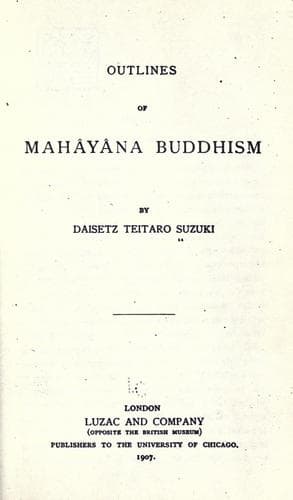
Outlines of Mahayana BuddhismSuzuki, Daisetz Teitaro
Religion
Outlines of Mahayana Buddhism
Suzuki, Daisetz Teitaro
Mahayana Buddhism -- Doctrines
The Bodhicitta or Intelligence-heart, therefore, like the Dharmakâya
is essentially love and intelligence, or, to use Sanskrit terms,
_karunâ_ and _prajñâ_. Here some may object to the use of the term
“love” for karunâ, perhaps on the ground that karunâ does not exactly
correspond to the Christian notion of love, as it savors more of the
sense of commiseration. But if we understand by love a sacrifice of
the self for the sake of others (and it cannot be more than that),
then karunâ can correctly be rendered love, even in the Christian
sense. Is not the Bodhisattva willing to abandon his own Nirvanic
peace for the interests of suffering creatures? Is he not willing to
dedicate the karma of his meritorious deeds performed in his
successive existences to the general welfare of his fellow-beings? Is
not his one fundamental motive that governs all his activities in life
directed towards a universal emancipation of all sentient beings? Is
he not perfectly willing to forsake all the thoughts and passions that
arise from egoism and to embrace the will of the Dharmakâya? If this
be the case, then there is {297} no reason why karunâ should not
be rendered by love.
Christians say that without love we are become sounding brass or a
tinkling cymbal; and Buddhists would declare that without karunâ we
are like unto a dead vine hanging over a frozen boulder, or like unto
the cold ashes left after a blazing fire.
Some may say, however, that the Buddhist sympathy or commiseration
somewhat betrays a sense of passive contemplation on evils. When
Christians say that God loves his creatures, the love implies activity
and shows God’s willingness to do whatever for the actual benefits of
his subject-beings. Quite true. Yet when the Buddha is stated to have
declared that all sentient beings in the triple world are his own
children or that he will not enter into his final Nirvana unless all
beings in the three thousand great chiliocosms, not a single soul
excepted, are emancipated from the misery of birth and death, his
self-sacrificing love must be considered to be all-comprehensive and
at the same time full of energy and activity. Whatever objections
there may be, we do not see any sufficient reason against speaking of
the love-essence of the Dharmakâya and the Bodhicitta.
_Nâgârjuna and Sthiramati on the Bodhicitta._
Says Nâgârjuna in his _Discourse on the Transcendentality of the
Bodhicitta_: “The Bodhicitta is free from all determinations, that is,
it is not included in the categories of the five skandhas, the twelve
âyatanas, and the eighteen dhâtus. It is not a particular {298}
existence which is palpable. It is non-atmanic, universal. It is
uncreated and its self-essence is void [_çûnya_, immaterial, or
transcendental].
“One who understands the nature of the Bodhicitta sees everything with
a loving heart, for love is the essence of the Bodhicitta.
“The Bodhicitta is the highest essence.
Public-domain text, read in full here on John Shaqi.
Reviews
Reviews
No reviews yet
Be the first to share your thoughts on this work.
Elsewhere in the archive
Join the Discussion
Join the discussion
Sign in to leave a comment or review.
Sign InorCreate an account