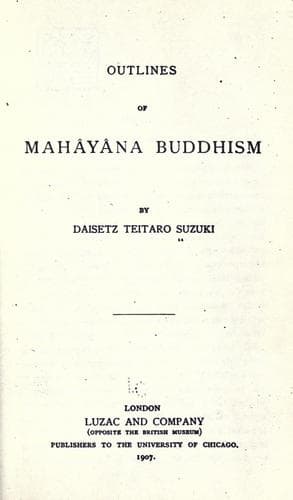
Outlines of Mahayana BuddhismSuzuki, Daisetz Teitaro
Religion
Outlines of Mahayana Buddhism
Suzuki, Daisetz Teitaro
Mahayana Buddhism -- Doctrines
Religion is the inmost voice of the human heart that under the yoke of
a seemingly finite existence groans and travails in pain. Mankind,
from their first appearance on earth, have never been satisfied with
the finiteness and impermanency of life. They have always been
yearning after something that will liberate them from the slavery of
this mortal coil, or from the cursed bondage of metempsychosis, as
Hindu thinkers express it. This something, however, on account of its
transcending all the principles of separation and individuation, which
characterise the phenomena of this mundane existence, has always
remained as something indefinite, inadequate, chaotic, and full of
mystery. And, according to different degrees of intellectual
development in different ages and nations, people have endeavored to
invest this {25} mysterious something with all sorts of human feelings
and intelligence. Most of modern scientists are now content with the
hypothesis that the mystery is unfathomable by the human mind, which
is conditioned by the law of relativity, and that our business here,
moral as well as intellectual, can be executed without troubling
ourselves with this ever-haunting problem of mystery;--this doctrine
is called agnosticism.
But this hypothesis can in no wise be considered the final sentence
passed on the mystery. From the scientific point of view, the maxim of
agnosticism is excellent, as science does not pretend to venture into
the realm of non-relativity. Dissatisfaction, however, presents itself,
when we attempt to silence by this hypothesis the last demand of the
human heart.
_Intellect and Imagination._
The human heart is not an intellectual crystal. When the intellect
displays itself in its full glory, the heart still aches and struggles
to get hold of something beyond. The intellect may sometimes declare
that it has at last laid its hand on what is demanded by the heart.
Time passes on, and the mystery is examined from the other points that
escaped consideration before, and, to the great disappointment of the
heart, the supposed solution is found to be wanting. The intellect is
baffled. But the human heart never gets tired of its yearnings and
demands a satisfaction ever more pressingly. Should they be considered
a mere nightmare of imagination? Surely {26} not, for herein lies the
field where religion claims supreme authority, and its claim is
perfectly right.
But religion cannot fabricate whatever it pleases; it must work in
perfect accord with the intellect. As the essential nature of man does
not consist solely in intellect, or will, or feeling, but in the
coördination of these psychical elements, religion must guard herself
against the unrestrained flight of imagination. Most of the
superstitions fondly cherished by a pious heart are due to the
disregard of the intellectual element in religion.
Public-domain text, read in full here on John Shaqi.
Reviews
Reviews
No reviews yet
Be the first to share your thoughts on this work.
Join the Discussion
Join the discussion
Sign in to leave a comment or review.
Sign InorCreate an account