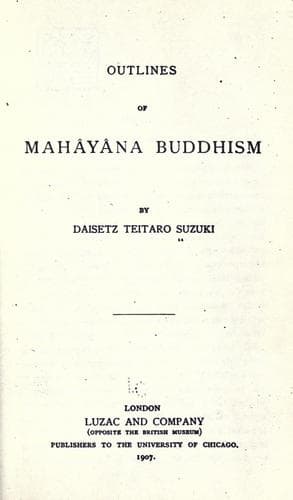
Outlines of Mahayana BuddhismSuzuki, Daisetz Teitaro
Religion
Outlines of Mahayana Buddhism
Suzuki, Daisetz Teitaro
Mahayana Buddhism -- Doctrines
“Therefore, all Bodhisattvas find their raison d’être of existence in
this great loving heart.
“The Bodhicitta, abiding in the heart of sameness (_samatâ_) creates
individual means of salvation (_upaya_).[125] {299} One who
understands this heart becomes emancipated from the dualistic view of
birth and death and performs such acts as are beneficial both to
oneself and to others.”
Sthiramati advocates in his _Discourse on the
Mahâyâna-Dharmadhâtu_[126] the same view as Nâgârjuna’s on the
nature of the Bodhicitta, which I summarise here: “Nirvâna, Dharmakâya,
Tathâgata, Tathâgata-garbha, Paramârtha, Buddha, Bodhicitta, or
Bhûtatathâtâ,--all these terms signify merely so many different
aspects of one and the same reality; and Bodhicitta is the name given
to a form of the Dharmakâya or Bhûtatathâtâ as it manifests itself in
the human heart, and its perfection, or negatively its liberation from
all egoistic impurities, constitutes the state of Nirvana.”
Being a reflex of the Dharmakâya, the Bodhicitta is practically the
same as the original in all its characteristics; so continues
Sthiramati: “It is free from compulsive activities; it has no
beginning, it has no end; it cannot be defiled by impurities, it
cannot be obscured by egoistic individualistic prejudices; it is
incorporeal, it is the spiritual essence of Buddhas, {300} it is the
source of all virtues earthly as well as transcendental; it is
constantly becoming, yet its original purity is never lost.
“It may be likened unto the ever-shining sunlight which may
temporarily be hidden behind the clouds. All the modes of passion and
sin arising from egoism may sometimes darken the light of the
Bodhicitta, but the Citta itself forever remains free from these
external impurities. It may again be likened unto all-comprehending
space which remains eternally identical, whatever happenings and
changes may occur in things enveloped therein. When the Bodhicitta
manifests itself in a relative world, it looks as if being subject to
constant becoming, but in reality it transcends all determinations, it
is above the reach of birth and death (_samsâra_).
“So long as it remains buried under innumerable sins arising from
ignorance and egoism, it is productive of no earthly or heavenly
benefit. Like the lotus-flower whose petals are yet unfolded, like the
gold that is deeply entombed under the débris of dung and dirt, or
like the light of the full moon eclipsed by Açura; the Bodhicitta,
when blindfolded by the clouds of passion, avarice, ignorance, and
folly, does not reveal its intrinsic spiritual worth.
Public-domain text, read in full here on John Shaqi.
Reviews
Reviews
No reviews yet
Be the first to share your thoughts on this work.
Elsewhere in the archive
Join the Discussion
Join the discussion
Sign in to leave a comment or review.
Sign InorCreate an account