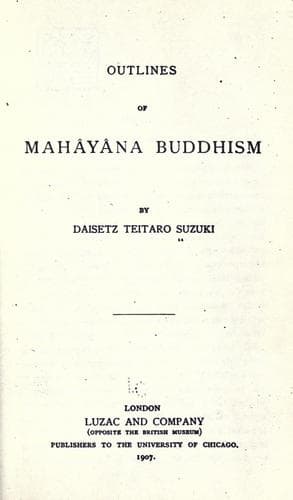
Outlines of Mahayana BuddhismSuzuki, Daisetz Teitaro
Religion
Outlines of Mahayana Buddhism
Suzuki, Daisetz Teitaro
Mahayana Buddhism -- Doctrines
same and in which there is no production and dissolution.
(7) _The Dûrangamâ._
Dûrangamâ means “going far away.” The Bodhisattva enters upon this
stage by attaining the so-called {320} Upâyajñâ, i.e. the knowledge
that enables him to produce any means or expediency suitable for his
work of salvation. He himself abides in the principles of _çûnyatâ_
(transcendentality), _animitta_ (non-individuality), and _apranihita_
(desirelessness), but his lovingkindness keeps him busily engaged
among sentient beings. He knows that Buddhas are not creatures
radically and essentially different from himself, but he does not stop
tendering them due homage. He is always contemplating on the nature of
the Absolute, but he does not abandon the practice of accumulating
merits. He is no more encumbered with worldly thoughts, yet he does
not disdain managing secular affairs. He keeps himself perfectly aloof
from the consuming fire of passion, but he plans all possible means
for the sake of sentient beings to quench the enraging flames of
avarice (_lobha_), anger (_dveṣa_), and infatuation (_moha_). He
knows that all individual existences are like dream, mirage, or the
reflection of the moon in the water, but he works and toils in the
world of particulars and submits himself to the domination of karma.
He is well aware of the transcendental nature of Pure Land
(_sukhâvatî_), but he describes it with material colors for the sake
of unenlightened masses. He knows that the Dharmakâya of all the
Buddhas is not a material existence, but he does not refuse to dignify
himself with the thirty-two major and eighty minor excellent features
of a great man or god (_mahâpuruṣa_). He knows that the language of
all the Buddhas does not fall within the ken of human comprehension,
but {321} he endeavors with all contrivances (_upâya_) to make it
intelligible enough to the understanding of people. He knows that all
the Buddhas perceive the past, present, and future in the twinkling of
an eye, but he adapts himself to divers conditions of the material
world and endeavors to help sentient beings to understand the
significance of the Bodhi according to their destinies and
dispositions. In short, the Bodhisattva himself lives on a higher
plane of spirituality far removed from the defilements of worldliness;
but he does not withdraw himself to this serene, unmolested
subjectivity; he boldly sets out in the world of particulars and
senses; and, placing himself on the level of ignorant beings, he works
like them, he toils like them, and suffers like them; and he never
fails all these times to practise the gospel of lovingkindness and to
turn over (_parivarta_) all his merits towards the emancipation and
spiritual edification of the masses, that is, he never gets tired of
practising the ten virtues of perfection (_pâramitâ_).
Public-domain text, read in full here on John Shaqi.
Reviews
Reviews
No reviews yet
Be the first to share your thoughts on this work.
Elsewhere in the archive
Join the Discussion
Join the discussion
Sign in to leave a comment or review.
Sign InorCreate an account