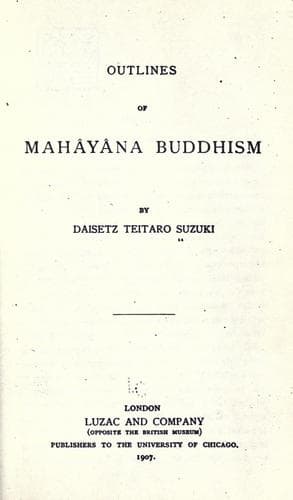
Outlines of Mahayana BuddhismSuzuki, Daisetz Teitaro
Religion
Outlines of Mahayana Buddhism
Suzuki, Daisetz Teitaro
Mahayana Buddhism -- Doctrines
That is to say, (1) the Bodhisattva practises the virtue of charity
(_dâna_) by freely giving away to all sentient creatures all the
merits that he has acquired by following the path of Buddhas. (2) He
practises the virtue of good conduct (_çîla_) by destroying all the
evil passions that disturb serenity of mind. (3) He practises the
virtue of patience (_kṣânti_), for he never gets irritated or excited
over what is done to him by ignorant beings. (4) He practises the
virtue of strenuousness (_vriya_), for he never gets tired of {322}
accumulating merits and of promoting good-will among his
fellow-creatures. (5) He practises the virtue of calmness (_dhyâna_),
for his mind is never distracted in steadily pursuing his way to
supreme knowledge. (6) He practises the virtue of intelligence
(_prajñâ_), for he always restrains his thoughts from wandering away
from the path of absolute truth. (7) He practises the virtue of
tactfulness (_upâya_), for he has an inexhaustible mine of
expediencies ready at his command for the work of universal salvation.
(8) He practises the virtue of will-to-do (_pranidhâna_) by
determinedly following the dictates of the highest intelligence. (9)
He practises the virtue of strength (_bala_), for no evil influences,
no heretical thoughts can ever frustrate or slacken his efforts for
the general welfare of people. (10) Finally, he practises the virtue
of knowledge, (_jñâna_), by truthfully comprehending and expounding
the ultimate nature of beings.
(8) _The Acalâ._
Acalâ, “immovable,” is the name for the eighth stage of
Bodhisattvahood. When a Bodhisattva, transcending all forms of
discursive or deliberate knowledge, acquires the highest, perfect
knowledge called _anutpattikadharmakṣânti_, he is said to have gone
beyond the seventh stage. Anutpattikadharmakṣânti literally means
“not-created-being-forbearance”; and the Buddhists use the term in the
sense of keeping one’s thoughts in conformity to the views that
nothing in this world {323} has ever been created, that things are
such as they are, i.e. they are Suchness itself. This knowledge is
also called non-conscious or non-deliberate knowledge in
contradistinction to relative knowledge that constitutes all our
logical and demonstrative knowledge. Strictly speaking, this so-called
knowledge is not knowledge in its ordinary signification, it is a sort
of unconscious or subconscious intelligence, or immediate knowledge as
some call it, in which not only willing and acting, but also knowing
and willing are one single, undivided exhibition of activity, all
logical or natural transition from one to the other being altogether
absent. Here indeed knowledge is will and will is action; “Let there
be light,” and there is light, and the light is good; it is the state
of a divine mind.
Public-domain text, read in full here on John Shaqi.
Reviews
Reviews
No reviews yet
Be the first to share your thoughts on this work.
Elsewhere in the archive
Join the Discussion
Join the discussion
Sign in to leave a comment or review.
Sign InorCreate an account