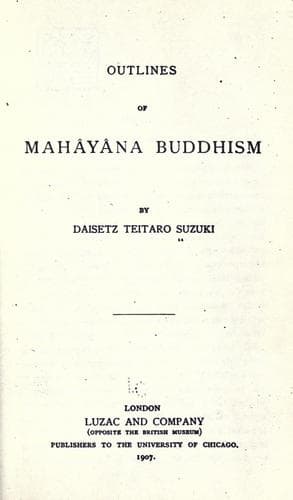
Outlines of Mahayana BuddhismSuzuki, Daisetz Teitaro
Religion
Outlines of Mahayana Buddhism
Suzuki, Daisetz Teitaro
Mahayana Buddhism -- Doctrines
In fact, Nirvâna literally means “extinction” or “dissolution” of the
five skandhas, and therefore it may be said that the entering into
Nirvâna is tantamount to the annihilation of the material existence
and of all the passions. Catholic Buddhists, however, do not understand
Nirvâna in the sense of emptiness, for they say that Buddhism is not a
religion of death nor for the dead, but that it teaches how to attain
eternal life, how to gain an insight into the real nature of things,
and how to regulate our conduct {332} in accordance with the highest
truth. Therefore, Buddhism, when rightly understood in the spirit of
its founder, is something quite different from what it is commonly
supposed to be by the general public.
I will endeavor in the following pages to point out that Nirvâna in
the sense of a total annihilation of human activities, is by no means
the primary and sole object of Buddhists, and then proceed to
elucidate in what signification it is understood in the Mahâyâna
Buddhism and see what relative position Nirvâna in its Mahâyânistic
sense occupies in the body of Buddhism.
_Nihilistic Nirvâna not the First Object._
In order to see the true signification of Nirvâna, it is necessary
first to observe in what direction Buddha himself ploughed the waves
in his religious cruise and upon what shore he finally debarked. This
will show us whether or not Nirvâna as nihilistic nothingness is the
primary and sole object of Buddhism, to which every spiritual effort
of its devotees is directed.
If the attainment of negativistic Nirvâna were the sole aim of
Buddhism, we should naturally expect Buddha’s farewell address to be
chiefly dealing with that subject. In his last sermon, however, Buddha
did not teach his disciples to concentrate all their moral efforts on
the attainment of Nirvânic quietude disregarding all the forms of
activity that exhibit themselves in life. Far from it. He told them,
according to the _Mahânibbâna sutta_ (the Book of the Great {333}
decease, _S. B. E._ Vol. XI. p. 114) that “Decay is inherent in all
component things! Work out your salvation with diligence!” This
exhortation of the strenuous life is quite in harmony with the last
words of Buddha as recorded in Açvaghoṣa’s _Buddhacarita_ (Chinese
translation, Chap. XXVI). They were:
“Even if I lived a kalpa longer,
Separation would be an inevitable end.
A body composed of various aggregates,
Its nature is not to abide forever.
“Having finished benefiting oneself and others,
Why live I longer to no purpose?
Of gods and men that should be saved,
Each and all had been delivered.
“O ye, my disciples!
Without interruption transmit the Good Dharma!
Know ye that things are destined to decay!
Never again abandon yourselves to grief!
“But pursue the Way with diligence,
And arrive at the Home of No-separation!
I have lit the Lamp of Intelligence,
That shining dispels the darkness of the world.
Public-domain text, read in full here on John Shaqi.
Reviews
Reviews
No reviews yet
Be the first to share your thoughts on this work.
Elsewhere in the archive
Join the Discussion
Join the discussion
Sign in to leave a comment or review.
Sign InorCreate an account