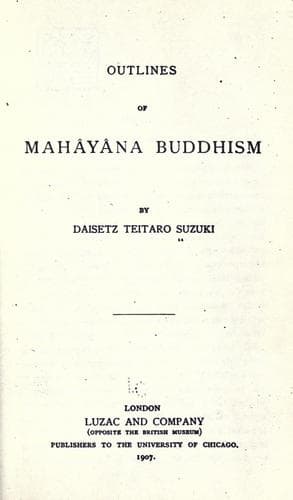
Outlines of Mahayana BuddhismSuzuki, Daisetz Teitaro
Religion
Outlines of Mahayana Buddhism
Suzuki, Daisetz Teitaro
Mahayana Buddhism -- Doctrines
“Know ye that the world endureth not!
As ye should feel happy [when ye see]
The parents suffering a mortal disease
Are released by a treatment from pain;
“So with me, I now give up the vessel of misery,
Transcend[135] the current of birth and death,
And am eternally released from all pain and suffering.
This too must be deemed blest.
{334}
“Ye should well guard yourselves!
Never give yourselves up to indulgence!
All that exists finally comes to an end!
I now enter into Nirvâna.”[136]
In this we find Buddha’s characteristic admonition to his disciples
not to waste time but to work out their salvation with diligence and
rigor, but we fail to find the gospel of annihilation, the supposedly
fundamental teaching of Buddhism.
Did then Buddha start in his religious discipline to attain the
absolute annihilation of all human aspirations and after a long
meditation reach the conclusion that contradicted his premises? Far
from it. His first and last ambition was nothing else than the
emancipation of all beings from ignorance, misery, and suffering
through enlightenment, knowledge, and truth. When Mâra the evil one
was exhausting all his evil powers upon the destruction of the Buddha
in the beginning of his career, the good gods in the heavens exclaimed
to the evil one:[137]
“Take not on thyself, O Mâra, this vain fatigue,--throw aside thy
malevolence and retire to thy home. This sage cannot be shaken by thee
any more than the mighty mountain Meru by the wind.
{335}
“Even fire might lose its hot nature, water its fluidity, earth its
steadiness, but never will he abandon his resolution, who has acquired
his merit by a long course of actions through unnumbered eons.
“Such is the purpose of his, that heroic effort, that glorious
strength, that compassion for all beings,--until he attains the
highest wisdom [or suchness, _tattva_], he will never rise from his
seat, just as the sun does not rise without dispelling the darkness.
“Pitying the world lying distressed amidst diseases and passions, he,
the great physician, ought not to be hindered, who undergoes all his
labors for the sake of the remedy-knowledge.
“He, who, when he beholds the world drowned in the great flood of
existence and unable to reach the further shore, strives to bring them
safely across,--would any right-minded soul offer him wrong?
“The tree of knowledge, whose roots go deep in firmness, and whose
fibres are patience,--whose flowers are moral actions and whose
branches are memory and thought,--and which gives out the Dharma as
its fruit,--surely when it is growing it should not be cut down.”
Public-domain text, read in full here on John Shaqi.
Reviews
Reviews
No reviews yet
Be the first to share your thoughts on this work.
Elsewhere in the archive
Join the Discussion
Join the discussion
Sign in to leave a comment or review.
Sign InorCreate an account