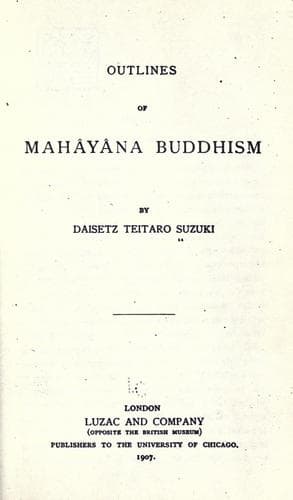
Outlines of Mahayana BuddhismSuzuki, Daisetz Teitaro
Religion
Outlines of Mahayana Buddhism
Suzuki, Daisetz Teitaro
Mahayana Buddhism -- Doctrines
(1) _Absolute Nirvâna_, as a synonym of the Dharmakâya. It is
eternally immaculate in its essence and constitutes the truth and
reality of all existences. Though it manifests itself in the world of
defilement and relativity, its essence forever remains undefiled.
While it embraces in itself innumerable incomprehensible spiritual
virtues, it is absolutely simple and immortal; its perfect
tranquillity may be likened unto space in which every conceivable
motion is possible, but which remains in itself the same. It is
universally present in all beings whether animate or inanimate[143]
and makes their existence real. In one respect it can be identified
with them, that is, it can be pantheistically viewed; but in the other
respect it is transcendental, {344} for every being as it is is not
Nirvâna. This spiritual significance is, however, beyond the ken of
ordinary human understanding and can be grasped only by the highest
intelligence of Buddha.
(2) _Upadhiçeṣa Nirvâna_, or Nirvâna that has some residue. This is a
state of enlightenment which can be attained by Buddhists in their
lifetime. The Dharmakâya which was dormant in them is now awakened and
freed from the “affective obstacles,”[144] but they are yet under the
bondage of birth and death; and thus they are not yet absolutely free
from the misery of life: something still remains in them that makes
them suffer pain.
(3) _Anupadhiçeṣa Nirvâna_, or Nirvâna that has no residue. This is
attained when the Tathâgata-essence (the Dharmakâya) is released from
the pain of birth and death as well as from the curse of passion and
sin. This form of Nirvâna seems to be what is generally understood by
Occidental missionary-scholars as the Nirvâna of Buddhists. While in
lifetime, they have been emancipated from the egoistic conception of
the soul, they have practised the Eightfold Path, and they {345} have
destroyed all the roots of karma that makes possible their
metempsychosis in the world of birth and death (_samsâra_), though as
the inevitable sequence of their previous karma they have yet to
suffer all the evils inherent in the material existence. But at last
they have had even this mortal coil dissolved away, and have returned
to the original Absolute from which by virtue of ignorance they had
come out and gone through a cycle of births and deaths. This state of
supramundane bliss in the realm of the Absolute is Anupadiçeṣa
Nirvâna, that is, Nirvâna that has no residue.
Public-domain text, read in full here on John Shaqi.
Reviews
Reviews
No reviews yet
Be the first to share your thoughts on this work.
Elsewhere in the archive
Join the Discussion
Join the discussion
Sign in to leave a comment or review.
Sign InorCreate an account