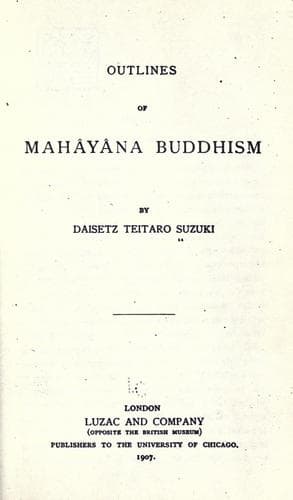
Outlines of Mahayana BuddhismSuzuki, Daisetz Teitaro
Religion
Outlines of Mahayana Buddhism
Suzuki, Daisetz Teitaro
Mahayana Buddhism -- Doctrines
(4) _The Nirvâna that has no abode._ In this, the Buddha-essence has
not only been freed from the curse of passion and sin (_kleça_), but
from the intellectual prejudice, which most tenaciously clings to the
mind. The Buddha-essence or the Dharmakâya is revealed here in its
perfect purity. All-embracing love and all-knowing intelligence
illuminate the path. He who has attained to this state of subjective
enlightenment is said to have no abode, no dwelling place, that is to
say, he is no more subject to the transmigration of birth and death
(_samsâra_), nor does he cling to Nirvâna as the abode of complete
rest; in short, he is above Samsâra and Nirvâna. His sole object in
life is to benefit all sentient beings to the end of time; but this he
proposes to do not by his human conscious elaboration and striving.
Simply actuated by his all-embracing love which is of the Dharmakâya,
he wishes to deliver all his fellow-creatures from misery, he does
{346} not seek his own emancipation from the turmoil of life. He is
fully aware of the transitoriness of worldly interests, but on this
account he desires not to shun them. With his all-knowing intelligence
he gains a spiritual insight into the ultimate nature of things and
the final course of existence. He is one of those religious men “that
weep, as though they wept not; that rejoice as though they rejoiced
not; that buy, as though they possessed not; that use this world, as
not abusing it; for the fashion of this world passes away.” Nay, he is
in one sense more than this; his life is full of positive activity,
because his heart and soul are devoted to the leading of all beings to
final emancipation and supreme bliss. When a man attains to this stage
of spiritual life, he is said to be in the Nirvâna that has no abode.
A commentator on the _Vijñânamâtra Çâstra_ adds that of these four
forms of Nirvâna the first is possessed by every sentient being,
whether it is actualised in its human perfection or lying dormant _in
posse_ and miserably obscured by ignorance; that the second and third
are attained by all the Çrâvakas and Pratyekabuddhas, while it is a
Buddha alone that is in possession of all the four forms of Nirvâna.
_Nirvâna as the Dharmakâya._
Public-domain text, read in full here on John Shaqi.
Reviews
Reviews
No reviews yet
Be the first to share your thoughts on this work.
Elsewhere in the archive
Join the Discussion
Join the discussion
Sign in to leave a comment or review.
Sign InorCreate an account