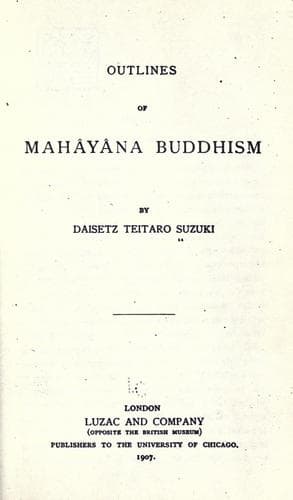
Outlines of Mahayana BuddhismSuzuki, Daisetz Teitaro
Religion
Outlines of Mahayana Buddhism
Suzuki, Daisetz Teitaro
Mahayana Buddhism -- Doctrines
Suppose a torch light is taken into a dark cell, which people had
hitherto imagined to be the abode of hideous, uncanny goblins, and
which on that account they wanted to have completely destroyed to the
{357} ground. The bright light now ushered in at once disperses the
darkness, and every nook and corner therein is perfectly illumined.
Everything in it now assumes its proper aspect. And to their surprise
people find that those figures which they formerly considered to be
uncanny and horrible are nothing but huge precious stones, and they
further learn that every one of those stones can be used in some way
for the great benefit of their fellow-creatures. The dark cell is the
human heart before the enlightenment of Nirvâna, the torch light is
love and intelligence. When love warms and intelligence brightens, the
heart finds every passion and sinful desire that was the cause of
unbearable anguish now turned into a divine aspiration. The heart
itself, however, remains the same just as much as the cell, whose
identity was never affected either by darkness or by brightness. This
parable nicely illustrates the Mahâyânistic doctrine of the identity
of Nirvâna and Samsâra, and of the Bodhi and Kleça, that is, of
intelligence and passion.
Therefore, it is said:
“All sins transformed into the constituents of enlightenment!
The vicissitudes of Samsâra transformed into the beatitude of Nirvâna!
All these come from the exercise of the great religious discipline
(_upâya_);
Beyond our understanding, indeed, is the mystery of all Buddhas.”[153]
{358}
_The Middle Course._
In one sense the Buddha always showed an eclectic, conciliatory,
synthetic spirit in his teachings. He refused to listen to any extreme
doctrine which elevates one end too high at the expense of the other
and culminates in the collapse of the whole edifice. When the Buddha
left his seat of enlightenment under the Bodhi tree, he made it his
mission to avoid both extremes, asceticism and hedonism. He proved
throughout his life to be a calm, dignified, thoughtful,
well-disciplined person, and at no time irritable in character,--in
this latter respect being so different from the sage of Nazareth, who
in anger cast out all the tradesmen in the temple and overthrew the
tables of the money-changers, and who cursed the fig tree on which he
could not find any fruit but leaves unfit to appease his hunger. The
doctrine of the Middle Path (_Mâdhyamârga_), whatever it may mean
morally and intellectually, always characterised the life and doctrine
of Buddha as well as the later development of his teachings. His
followers, however different in their individual views, professed as a
rule to pursue steadily the Middle Path as paved by the Master. Even
when Nâgârjuna proclaimed his celebrated doctrine of Eight No’s which
seems to superficial critics nothing but an absolute nihilism, he said
that the Middle Path could be found only in those eight no’s.[154]
{359}
Public-domain text, read in full here on John Shaqi.
Reviews
Reviews
No reviews yet
Be the first to share your thoughts on this work.
Elsewhere in the archive
Join the Discussion
Join the discussion
Sign in to leave a comment or review.
Sign InorCreate an account