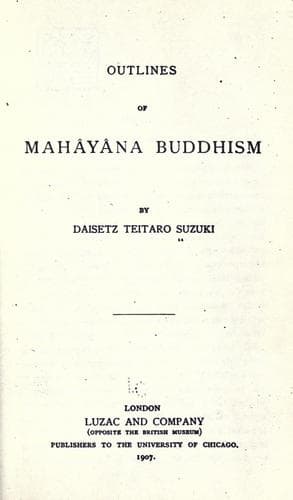
Outlines of Mahayana BuddhismSuzuki, Daisetz Teitaro
Religion
Outlines of Mahayana Buddhism
Suzuki, Daisetz Teitaro
Mahayana Buddhism -- Doctrines
Mahâyânism has certainly applied this synthetic method of Buddha to
its theory of Nirvâna and ennobled it by fully developing its immanent
signification. In the _Discourse on Buddha-essence_, Vasubandhu quotes
the following passage from the _Çrimala Sûtra_, which plainly shows
the path along which the Mahâyânists traveled before they reached
their final conclusion: “Those who see only the transitoriness of
existence are called nihilists, and those who see only the eternality
of Nirvâna are called eternalists. Both views are incorrect.”
Vasubandhu then proceeds to say: “Therefore, the Dharmakâya of the
Tathâgata is free from both extremes, and on that account it is called
the Great Eternal Perfection. When viewed from this absolute standpoint
of Suchness, the logical distinction between Nirvâna and Samsâra cannot
in reality be maintained, and hereby we enter upon the realm of
non-duality.” And this realm of non-duality is the Middle Path of
Nirvâna, not in its nihilistic, but in its Mahâyânistic, significance.
_How to Realise Nirvâna._
How can we attain the Middle Path of Nirvâna? How can we realise a
life that is neither pessimistic asceticism nor materialistic
hedonism? How can we steer through the whirlpools of Samsâra without
being {360} swallowed up and yet braving their turbulent gyration? The
answer to this can readily be given, when we understand, as repeatedly
stated above, that this life is the manifestation of the Dharmakâya,
and that the ideal of human existence is to realise within the
possibilities of his mind and body all that he can conceive of the
Dharmakâya. And this we have found to be all-embracing love and
all-seeing intelligence. Destroy then your ignorance at one blow and
be done with your egoism, and there springs forth an eternal stream of
love and wisdom.
Says Vasubandhu: “By virtue of Prajñâ [intelligence or wisdom], our
egoistic thoughts are destroyed: by virtue of Karuṇâ [love],
altruistic thoughts are cherished. By virtue of Prajñâ, the
[affective] attachment inherent in vulgar minds is abolished; by
virtue of Karuṇâ, the [intellectual] attachment as possessed by the
Çrâvakas and Pratyekabuddhas is abolished. By virtue of Prajñâ,
Nirvâna [in its transcendental sense] is not rejected; by virtue of
Karuṇâ, Samsâra [with its changes and transmigrations] is not rejected.
By virtue of Prajñâ the truth of Buddhism is attained; by virtue of
Karuṇâ, all sentient beings are matured [for salvation].”
Public-domain text, read in full here on John Shaqi.
Reviews
Reviews
No reviews yet
Be the first to share your thoughts on this work.
Elsewhere in the archive
Join the Discussion
Join the discussion
Sign in to leave a comment or review.
Sign InorCreate an account