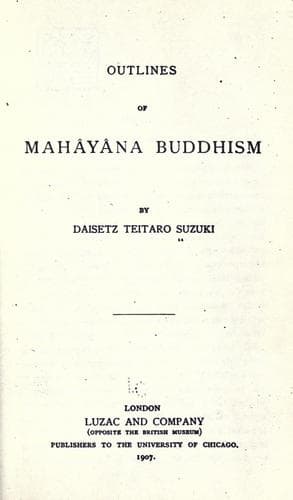
Outlines of Mahayana BuddhismSuzuki, Daisetz Teitaro
Religion
Outlines of Mahayana Buddhism
Suzuki, Daisetz Teitaro
Mahayana Buddhism -- Doctrines
[a01] This and the following are translations from some Mahâyâna texts
in the Buddhist Tripitaka, which were rendered into the Chinese
language at various times from Sanskrit mostly through the co-operation
of the Hindu missionaries and Chinese scholars. A detailed analysis of
these texts is most urgently needed, as they contain many informations
of great importance not only concerning the history of Buddhism in
India but also concerning early Hindu culture generally. A rather
incomplete idea as to their contents and material and general character
will be attained by the perusal of Rev. Nanjo’s _Catalogue of the
Chinese Tripitaka_, Oxford, 1883.
_Mahâyâna-mûlajâta-hṛdayabhûmi-dhyâna Sûtra_, (Nanjo, no. 955,) fas.
iii.
[a02] The _Avatamsaka_, fas. xiv., p. 73.
[a03] _The Avatamsaka_, (Buddhabhadra’s translation), fas. xiv, p. 72.
[a04] To conceive the Tathâgata as a personal being who appeared on
earth for a certain limited time and then eternally disappeared is not
Mahâyânistic. He reveals himself constantly and of his own will in
this world of particulars.
[a05] _Sarvadharma-pravṛtti-nirdeça Sûtra_ (Nanjo, no. 1012).
[a06] _Mahâyâna-mûlajâta-hrdavabhûmi-dhyâna Sûtra_ (Nanjo 955), fas.
iii, p. 75.
[a07] The three rings are: 1. the giver, 2. the receiver, and 3. the
thing given, material or immaterial.
[a08] Precepts. The three sets are: 1. one relating to good behavior,
2. to the accumulation of merit, and 3. to lovingkindness toward all
beings.
{406}
[a09] The mental (subjective), physical (objective), and oral.
[a10] The intellectual and the affective.
[a11] _Sarvadharma-pravṛtti-nirdeça Sûtra._
[a12] Literally, “when greed is neither born nor dead.” This means, to
live in the world as not living in it. This subjective divine
innocence is thought by Buddhists the essence of the religious life.
The consciousness of one’s worth, or self-conceit, is a great obstacle
in the path of perfect virtue. As in the case of mechanical work or
physical exercise, we attain perfect skillfulness only when the work
is involuntarily done, i.e., without any conscious effort on the part
of the performer; so in our moral and spiritual life we attain the
height of virtuousness or saintliness when we identify ourselves with
the reason of our being. This is Laotze’s doctrine of non-action or
non-resistance, and also the teaching of the _Bhagavadgîta_. As
remarked elsewhere, when a man reaches this stage of religious life,
he ceases to be human, but divine, in the sense that he transcends the
world of good and evil and eternally abides in the realm of the
beautiful.
[a13] This is a very radical statement and is enough to frighten timid
moralists and “God-fearing” pietists. Therefore, it is said that “Give
not that which is holy to the dogs, neither cast ye your pearls before
swine.” But think not that this is expounding antinomianism.
[a14] This and all the following are taken from the _Kâṣyapa-Parivarta_
(Nanjo, 805).
Public-domain text, read in full here on John Shaqi.
Reviews
Reviews
No reviews yet
Be the first to share your thoughts on this work.
Elsewhere in the archive
Join the Discussion
Join the discussion
Sign in to leave a comment or review.
Sign InorCreate an account