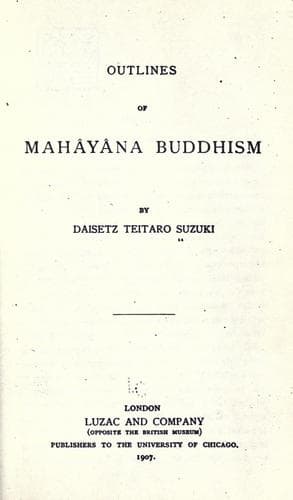
Outlines of Mahayana BuddhismSuzuki, Daisetz Teitaro
Religion
Outlines of Mahayana Buddhism
Suzuki, Daisetz Teitaro
Mahayana Buddhism -- Doctrines
[a15] This gâthâ may not be very intelligible to our readers. The
sense is: Whatever is done by a Buddha or Bodhisattva does not come
from logical calculation or deliberate premeditation, but immediately
from his inmost heart, which, in most natural and freest manner,
responds to the needs of the suffering. This response is altogether
free from all human elaboration, for the Buddha shows no painful and
struggling efforts in so doing. Everything he does is like the work of
nature herself. His life is above the narrow sphere of human morality
which is marked with a desperate struggle between good and evil. His
is in the realm of the divinely beautiful.
{407}
[a16] “Having no selfhood” (_svabhâva_), means that things have no
independent existence, no self-nature which will eternally preserve
their thingish identity. This theory has been explained in the chapter
dealing with the doctrine of non-atman. To state summarily, darkness
and light are conditioned by each other; apart from darkness there is
no light, and conversely, without light darkness has no meaning. Even
so with enlightenment and ignorance: one independent of the other,
they have no existence, they cannot be conceived. They are like
imaginary flowers in the air projected there by a confused
subjectivity. They are nothing but our ideal fabrication. To cling to
God only, forgetting that we are living in the world below, in the
world of relativity, is just as much one-sided as to lose ourselves in
the whirlpool of earthly pleasures without the thought of God. Life,
however, is not antithetic, but synthetic. Truth is never one-sided,
it is always in the middle. Therefore, seek enlightenment in ignorance
and truth in error. A dualistic interpretation of the world and life
is not approved by Buddhists. Compare the sentiment expressed herein
with Emerson’s poem as elsewhere quoted, in which these lines occur:
“But in the mud and scum of things,
There always, always, something sings.”
[a17] _The Kâṣyapaharivarta Sûtra_ (Nanjo, 805.).
[a18] The sense is: The Bodhisattva never desires a complete
absorption in the Absolute, in which no individual existences are
distinguishable. He always leaves the “Will to live” unhurt, as it
were, so that he could come in this world of particulars ever and
anon. What he has destroyed is the egoistic assertion of the Will, for
the aim of Buddhism is not to remove the eternal principle of life,
but to manifest it in its true significance. The wishes of the
Bodhisattva, therefore, are never egocentric; he knows that
transmigration and rebirth are painful, but as it is by rebirth alone
that he could mingle himself in the world of sin and save the
suffering creatures therein, he never shuns the misery of life. His
work of revelation is constant and eternal.
[a19] _The Mahâyâna-mûlajâti-hrdayabhûmi-dhyâna Sûtra_, fas. IV.
{408}
Public-domain text, read in full here on John Shaqi.
Reviews
Reviews
No reviews yet
Be the first to share your thoughts on this work.
Elsewhere in the archive
Join the Discussion
Join the discussion
Sign in to leave a comment or review.
Sign InorCreate an account