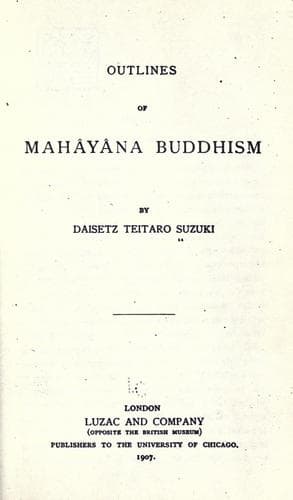
Outlines of Mahayana BuddhismSuzuki, Daisetz Teitaro
Religion
Outlines of Mahayana Buddhism
Suzuki, Daisetz Teitaro
Mahayana Buddhism -- Doctrines
Dharmakâya, Mahâyâna, 7; briefly explained, 20, 45 et seq.; the
highest principle, 35; and Brahman, 46; and Paramâtman, 46; and God of
Christians, 46; as love and wisdom, 46, 54, 55; and non-ego, 47; and
the Golden Rule, 48; and Bodhisattvas, 61; its universal incarnation,
63 ft.; in the Trikâya, 73, 257; as perfect knowledge, 92; and prajñâ,
94; as a cosmic mind, 123; a unity, 193; and Suchness, 217; as God,
219; as religious object, 222; in the _Avatamsaka Sutra_, 223; its
detailed characterisation, 224; in the phenomenal world, 231; as love,
232; as a loving heart in the _Avatamsaka_, 233; its seven
characteristics, 234; by Asanga and Vasubandhu, 234; its five modes of
operation, 235; its freedom, 236; its pûrvanidhânabala, 237; as
rational will, 238; as father, 239; and its perpetual revelation, 259;
the evolution of its conception, 272; all beings are one in, 290; and
the Bodhi, 295.
_Dharmapada_, The, quoted, 34, 145, 336, 368.
Dharmamegha (tenth stage of Bodhisattvahood), 326.
Dharmapala, the Anâgarika, 3 ft.
_Discourse on Buddha-Essence_, The, by Vasubandhu, 357.
Dûrangama (seventh stage of Bodhisattvahood), 319.
{413}
Ego, not the source of energy, 55; noumenal, 145, 163; phenomenal,
145; empirical, 163.
Egoism and the evolution of Manas, 134.
Ego-soul, and its attributes, 147; and the five skandhas, 149; located
by Ananda, 157; and the Christian flesh, 166; and the Vedantic
conception, 167 et seq.; and Nâgârjuna, 168; and svabhava, 171; and
Christians, 212; as conceived by Buddha when he started on his
religious career, 337. (_See also_ “Ego”, “âtman” and “soul”).
Ekacitta, (one mind or thought), 70 ft.
Elders, the School of, 248 et seq.
Elephant and the blind, 100.
Emerson, quoted, 29.
Enlightenment, 55, 119; and manas, 134; two obstacles to, 344 ft.
Faith, its contents vary, 27 et seq.
Fatalism, 196.
Gautama and Christ, 29. (_See also_ “Buddha”).
God, the Buddhist, 219. (_See also_ “Dharmakâya”).
Goethe’s Faust, quoted, 181.
Golden Rule, the, universal, 54.
Great Council School, the, 248 et seq.
Guyau, French sociologist, 50 ft., 84.
Hartmann’s Unbewusste, 137.
Hetus and Pratyayas, 33, 41, 142, 148.
Hînayânism, 1, 60, 63, 280.
Hugo, Victor, quoted, 58.
Hui-K’e, second patriarch of Zen sect, 148.
{414}
Iccantika (incapable of salvation), 311.
Ignorance, 35 et seq.; and evolution, 115; and consciousness, 120; no
evil, 122; when evil? 124; and Tathâgata-Garbha, 126; and Manas, 133;
and Prakrit, 138 ft.
_Imitation of Christ_, 364 fn.
Immortality, 38; and Dharmakâya, 54; karmaic and not individual, 214.
Injustice, social, and karma, 186
Intelligence, awakened by love, 362.
_Jâtaka Tales_, the, quoted, 156.
Jesus, 6.
Jîvâtman, 145.
Kant, 6; _Critique of Pure Reason_, quoted, 324.
Public-domain text, read in full here on John Shaqi.
Reviews
Reviews
No reviews yet
Be the first to share your thoughts on this work.
Elsewhere in the archive
Join the Discussion
Join the discussion
Sign in to leave a comment or review.
Sign InorCreate an account