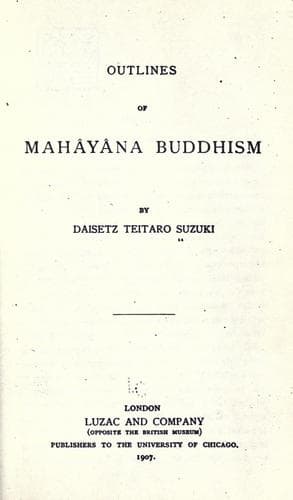
Outlines of Mahayana BuddhismSuzuki, Daisetz Teitaro
Religion
Outlines of Mahayana Buddhism
Suzuki, Daisetz Teitaro
Mahayana Buddhism -- Doctrines
Atonement, vicarious, 291 ft.
_Avatamsaka Sûtra_, The, on Bodhisattva’s reflections, 369 et seq.
Avenikas (unique features), 327 ft.
Avidyâ (ignorance), 35 et seq., 115.
Balas, the ten, of the Buddha, 327.
Beal, Samuel, refuted, 20 et seq. _Catena of Buddhist Scriptures_,
quoted, 157 ft.; _Romantic History of Buddha_, quoted, on Buddha’s
enlightenment, 337.
_Bhagavadgîta_, quoted, 126 ft.
Bhûtatathâtâ (Suchness), 99 et seq; and Mahâyâna, 7; and perfect
knowledge, 92.
Bodhi (wisdom), 46; and Prajñâ etc., defined, 82 ft.; as perfect
knowledge, 92; its meaning explained, 294; by Nâgârjuna, 297; as a
reflex of Dharmakâya, 299; how awakened in human heart, 302.
Bodhicitta (Intelligence-heart), 52. (_See also_ “Bodhi.”)
Bodhi-Dharma, of Dhyâna sect, 103, 149, 155.
Bodhipakshikas, the seven, 316 et seq.
Bodhisattva, above samsara and nirvana, 72; in the three yânas, 277;
the conception of, in primitive Buddhism, 286; we are, 290; and love,
292; his ten pranidhanas, 308; his reflections, 369.
Bodhisattvahood, ten stages of, 70, 311 et seq.
Bodhisattva-yâna, 9.
_Brahdaranyaka Upanishad_, quoted, 102 ft.
{411}
Buddha, and his self-relying spirit, 57; culmination of good karma,
215; in the Mahâyâna texts, 243; the idealisation of, historically
treated, 249 et seq.; in the Trikâya, 252; the human, and the
spiritual Dharmakâya, 255; his 32 major and 80 minor marks of
greatness, 271; in the process of idealisation, 289; in the
Mahâyânism, 291; and Mâra, 334; on the ego-soul in the beginning of
his religious career, 337.
_Buddhacarita_, quoted, 57.
Buddhadharma, 355.
_Buddha-Essence, Discourse on_, 357 ft.
Buddha-intelligence, 364.
Buddhism(s), geographically divided, 3, 4; two, 4 et seq.; and
atheism, 31; and the soul problem, 31 et seq.; and agnosticism, 35;
and modern psychology, 40; intellectual, 56 et seq.; liberal, 56 et
seq.; and speculation, 81 et seq.; and science, 97.
Buddhist(s) classified, 8 et seq.; life and love, 52; ideal, 53;
aspiration, 368; rule of conduct, 368.
Çâkyamuni contrasted to Devadatta, 200.
Carlyle’s _Hero-Worship_, quoted, 325 ft.
Causation, universal, and emptiness, 176.
Christ and Buddha, compared, 57, 58.
Christian conception of the ego-soul, 166.
Christianity, the growth of, compared with Mahâyânism, 12 et seq.; and
its founder, 13; not intellectual, 79.
Çikshas (moral rules), ten, 70 ft.
Confucius, 63 ft.
Consciousness, subliminal, 201.
Conservation of energy, and karma, 34.
Convictions, the four, of the Buddha, 327.
{412}
Çrâvaka, 277.
Çrâvaka-yâna, 9.
_Çrimâla Sûtra_, quoted, 127.
Çûnyatâ, (or çûnya), 22, 95; and Christian critics, 105; explained,
173; and universal causation, 176.
Daçabhûmi, (_see_ “ten stages of Bodhisattvahood”), 311, 329.
Deussen, P., quoted, 107.
Devala, 361, 364.
Dharma, its meaning, 21, 221.
Dharmadhatu, 115 ft., 193.
Public-domain text, read in full here on John Shaqi.
Reviews
Reviews
No reviews yet
Be the first to share your thoughts on this work.
Elsewhere in the archive
Join the Discussion
Join the discussion
Sign in to leave a comment or review.
Sign InorCreate an account