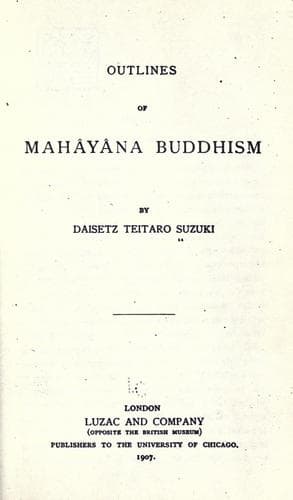
Outlines of Mahayana BuddhismSuzuki, Daisetz Teitaro
Religion
Outlines of Mahayana Buddhism
Suzuki, Daisetz Teitaro
Mahayana Buddhism -- Doctrines
[36] No efforts have yet been made systematically to trace the
history of the development of the Mahâyâna thoughts in India as well
as in China and Japan. We have enough material at least to follow the
general course it has taken, as far as the Chinese and Tibetan
collections of Tripitaka are concerned. When a thorough comparison by
impartial, unprejudiced scholars of these documents has been made with
the Pali and Sanskrit literature, then we shall be able to write a
comprehensive history of the human thoughts that have governed the
Oriental people during the last two thousand years. When this is done,
the result can further be compared with the history of other religious
systems, thus throwing much light on the general evolution of humanity.
[37] _Prajñâ_, _bodhi_, _buddhi_, _vidyâ_ and _jñâ_ or _jñâna_ are
all synonymous and in many cases interchangeable. But they allow a
finer discrimination. Speaking in a general way, _prajñâ_ is reason,
_bodhi_ wisdom or intelligence, _buddhi_ enlightenment, _vidyâ_
ideality or knowledge, and _jñâ_ or _jñâna_ intellect. Of these five
terms, _prajñâ_ and _bodhi_ are essentially Buddhistic and have
acquired technical meaning, In this work both _prajñâ_ and _bodhi_ are
mostly translated by intelligence, for their extent of meaning closely
overlaps each other. But this is rather vague, and wherever I thought
the term intelligence alone to be misleading, I either left the
originals untranslated, or inserted them in parentheses. To be more
exact, _prajñâ_ in many cases can safely be rendered by faith, not a
belief in revealed truths, but a sort of immediate knowledge gained by
intuitive intelligence. _Prajñâ_ corresponds in some respects to
wisdom, meaning the foundation of all reasonings and experiences. It
may also be considered an equivalent for Greek _sophia_. Bodhi, on the
other hand, has a decidedly religious and moral significance. Besides
being _prajñâ_ itself, it is also love (_karunâ_): for, according to
Buddhism, these two, _prajñâ_ and _karunâ_, constitute the essence of
Bodhi. May Bodhi be considered in some respects synonymous with the
divine wisdom as understood by Christian dogmatists? But there is
something in the Buddhist notion of Bodhi that cannot properly be
expressed by wisdom or intelligence. This seems to be due to the
difference of philosophical interpretation by Buddhists and Christians
of the conception of God. It will become clearer as we proceed farther.
CHAPTER IV NOTES.
[38] For detailed exposition of the three forms of knowledge, the
reader is requested to peruse Asanga’s _Comprehensive Treatise on
Mahâyânism_ (Nanjo’s Catalogue, No. 1183), Vasubandhu’s work on
Mahâyâna idealism (_Vijnânamâtra Çâstra_, Nanjo, No. 1215), the _Sûtra
on the Mystery of Deliverance_ (_Sandhinirmocana-sûtra_, Nanjo. Nos.
246 and 247), etc.
Public-domain text, read in full here on John Shaqi.
Reviews
Reviews
No reviews yet
Be the first to share your thoughts on this work.
Elsewhere in the archive
Join the Discussion
Join the discussion
Sign in to leave a comment or review.
Sign InorCreate an account