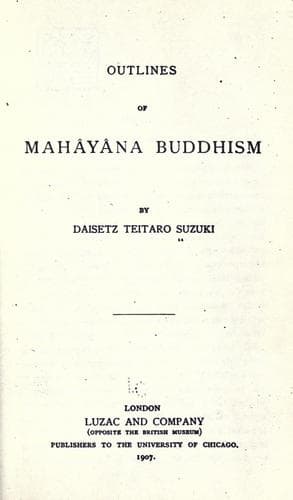
Outlines of Mahayana BuddhismSuzuki, Daisetz Teitaro
Religion
Outlines of Mahayana Buddhism
Suzuki, Daisetz Teitaro
Mahayana Buddhism -- Doctrines
[39] When the eminent representatives of both parties, such as
Dharmapala and Bhavaviveka, were at the height of their literary
activity in India about the fifth or sixth century after Christ, their
partisan spirit incited them bitterly to denounce each other,
forgetting the common ground on which their principles were laid down.
Their disagreement in fact on which they put an undue emphasis was of
a very trifling nature. It was merely a quarrel over phraseology, for
one insisted on using certain words just in the sense which the other
negated.
[40]
“Dve satye samupâçritya buddhânâm dhardeçanâ
Lokasamvṛttisatyañ ca satyañ ca paramârthataḥ.
Ye ca anayor na jânanti vibhâgam satyayor dvayoḥ,
Te tatvam na vijânanti gambhîrabuddhaçâsane.”
[41]
Vyavahâram anâçritya paramârtho na deçyate,
Paramârtham anâgamya nirvâṇam na adhigamyata.
_The Mâdhyamika_, p. 181.
CHAPTER V NOTES.
[42]
Cf. _The Udâna_, chapter VI.
[43]
Svabhâvam parabhâvanca, bhâvancâbhâvameva ca,
Ye paçyanti, na paçyante tatvam hi buddhaçâsane.
[44]
Astîti çâçvatagrâho, nâstîtyucchedadarçanam:
Tasmâdastitvanâstitve nâçriyeta vicaksanah
[45]
Astîti nâstîti ubhe ‘pi antâ
Çuddhî açuddhîti ime ‘pi antâ;
Tasmâdubhe anta vivarjayitvâ
Madhye ‘pi syânam na karoti paṇditah.
[46] This is the famous phrase in the _Brhadaranyaka Upanisad_
occurring in several places (II, 3, 6; III, 9, 26; IV, 2, 4; IV, 4,
22; IV, 5, 5). The Atman or Brahman, it says, “is to be described by
No, No! He is incomprehensible, for he cannot be comprehended; he is
imperishable, for he cannot perish; he is unattached, for he does not
attach himself; unfettered, he does not suffer, he does not fail. Him
(who knows), these two do not overcome, whether he says that for some
reason he has done evil, or for some reason he has done good--he
overcomes both, and neither what he has done, nor what he has omitted
to do, affects him.”
[47] _The Awakening of Faith_, p. 59. Cf. this with the utterances
of Dionysius the Areopagite, as quoted by Prof. W. James in his
_Varieties of Religious Experience_, pp. 416-417: “The cause of all
things is neither soul nor intellect; nor has it imagination, opinion,
or reason, or intelligence; nor is it spoken or thought. It is neither
number, nor order, nor magnitude, nor littleness, nor equality, nor
inequality, nor similarity, nor dissimilarity. It neither stands, nor
moves, nor rests.... It is neither essence, nor eternity, nor time.
Even intellectual contact does not belong to it. It is neither science
nor truth. It is not even royalty nor wisdom; not one; not unity; not
divinity or goodness; nor even spirit as we know it.”.... _ad libitum_.
[48]
Anirodham anutpâdam anucchedam açâçvatam,
Anekârtham anânârtham anâgamam anirgamam.
(_Mâdhyamika Çâstra_, first stanza.)
[49]
Public-domain text, read in full here on John Shaqi.
Reviews
Reviews
No reviews yet
Be the first to share your thoughts on this work.
Elsewhere in the archive
Join the Discussion
Join the discussion
Sign in to leave a comment or review.
Sign InorCreate an account