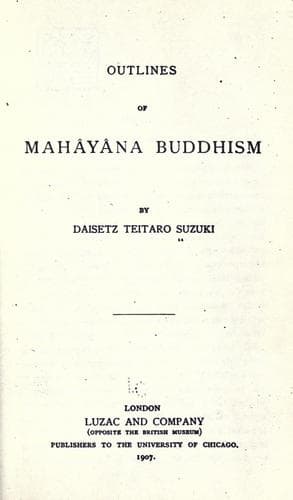
Outlines of Mahayana BuddhismSuzuki, Daisetz Teitaro
Religion
Outlines of Mahayana Buddhism
Suzuki, Daisetz Teitaro
Mahayana Buddhism -- Doctrines
Max Mueller in another place (op. cit. p. 210) speaks of the
Vedantists’ assertion of the reality of the objective world for
practical purposes (_vyavahârârtham_) and of their antagonistic
attitude toward “the nihilism of the Buddhists.” “The Buddhists” this
seems to refer to the followers of the Mâdhyamika school, but a careful
perusal of their texts will reveal that what they denied was not the
realness of the world as a manifestation of conditional Suchness, but
its independent realness and our attachment to it as such. The
Mâdhyamika school was not in any sense a nihilistic system. True, its
advocates used many negative terms, but what they meant by them was
obvious enough to any careful reader.
[56] Dharmadhâtu is the world as seen by an enlightened mind, where
all forms of particularity do not contradict one another, but make one
harmonious whole.
[57] The word literally means recollection or memory. Açvaghoṣa
uses it as a synonym of ignorance, and so do many other Buddhist
philosophers.
[58] _Smṛti_ or _citta_ or _vijñâna_. They are all used by Açvaghoṣa
and other Buddhist authors as synonymous. _Smṛti_ literally means
memory; _citta_, thought or mentation; and _vijñâna_ is generally
rendered by consciousness, though not very accurately.
CHAPTER VI NOTES.
[59] Cf. the _Bhagavadgîtâ_ (_S. B. E._ Vol. VIII, chap. XIV, p.
107): “The Brahman is a womb for me, in which I cast the seed. From
that, O descendant of Bharata! is the birth of all things. Of the
bodies, O son of Kunti! which are born from all wombs, the main womb
is the great Brahman, and I am the father, the giver of the seed.”
[60] This is translated from the Chinese of Çikṣananda; the Sanskrit
reads as follows:
“Tarangâ hi udadher yadvat pavanapratyaya îritâ,
Nṛtyamânâh pravartante vyucchedaç ca na vidhyate:
Âlayodhyas tathâ nityam viṣayapavana îritaḥ,
Cittâis tarangavijñânâir nṛtyamânâḥ pravartate.”
[61]
From the Chinese. The Sanskrit reads as follows:
“Nîle rakte ‘tha lavaṇe çankhe kṣîre ca çârkare,
Kaṣayâiḥ phalapuṣpâdyâih kiraṇâ yatha bhâskare:
No ‘nyena ca nânanyena tarangâ hi udadher matâ;
Vijñânâni tathâ sapta, cittena saha samyuktâ.
Udadheḥ pariṇâmo ‘sâu tarangânâm vicitratâ,
Âlayam hi tathâ cittam vijñânâkhyam pravartate;
Cittam manaç ca vijñânam lakṣaṇârtham prakalpyate;
Âbhinna lakṣanâ hi aṣtâu na lakṣyâ na ca lakṣaṇâ.
Udadheç ca tarangânâm yathâ nâsti viçeṣanâ.
Vijñânânam tathâ citte pariṇâmo na labhyate.
Cittena cîyate karmaḥ, manasâ ca vicîyate,
Vijñânena vijânâti, dṛçyam kalpeti pañcabhiḥ.”
Public-domain text, read in full here on John Shaqi.
Reviews
Reviews
No reviews yet
Be the first to share your thoughts on this work.
Elsewhere in the archive
Join the Discussion
Join the discussion
Sign in to leave a comment or review.
Sign InorCreate an account